
AI disclosure statement: AI was used in the transcriptions of interviews that contributed to this article.
Listen to the whole story here:
The rate of Canadian men and boys reporting domestic and intimate partner violence (IPV) rose faster than among women and girls between 2018 and 2025, but experts say men fleeing abuse have fewer shelter options available to them.
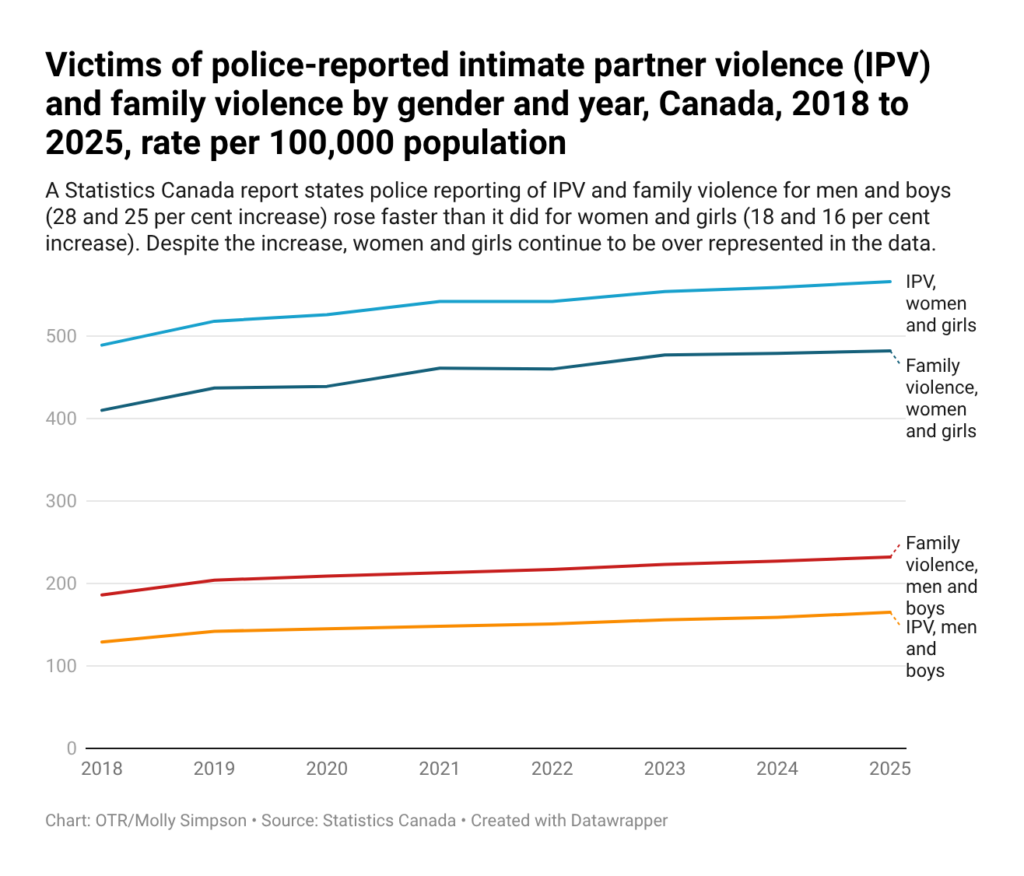
According to a recent Statistics Canada report, the rates at which men and boys reported domestic violence was 25 per cent compared to 16 per cent for women and girls. For IPV, men and boys reported at an increase of 28 per cent compared to 18 per cent for women and girls.
There are few domestic violence shelters in Canada that are specifically for men, according to Justin Trottier, the founder of the Canadian Centre for Men and Families. He said this isn’t enough, and that men’s needs in this specific area of police-reported violence are not taken seriously.
“We have a waiting list. We’re always having to decline to admit people just because we don’t have the capacity for it,” Trottier said. The Toronto centre has capacity for 10 families, he said.
While women and girls are still over represented in domestic violence statistics, women are more likely than men to report to police or use victim services. According to a separate Statistics Canada report, only four per cent of male victims of abuse reported it to police in 2025 and only seven per cent of male victims reported using victims services.
Trottier said he believes more men are victims of abuse than are reflected in the police reporting, and that there is not enough support for men experiencing domestic violence, saying there’s not enough investment in male programming.
“Yes, you do have homeless shelters for men. But unlike the domestic violence shelters for women…you do not have the kinds of support and resources that men just as well as women need when they’re fleeing domestic violence.”
The increase in reporting could be explained by two possibilities: an increase in violence or a willingness to report according to Alexandra Lysova, a researcher specializing in domestic violence against men from Simon Fraser University.
“To see this is very, very unusual. So that is why in some ways I think it may represent a certain increase in severity, so they don’t have [a] choice, they need to call the police, or there are injuries related to that.”
Lysova said men are less likely to recognize violence against themselves because it can be normalized, and this can also skew reporting.
While there are domestic violence centres in Canada that do provide help to men, Lysova said many domestic violence centres “explicitly focus on women,” and this can make men feel “unwelcome.”
Lysova said change begins with education and empathy. She said addressing dating violence as a general issue could help, as violence against men can be seen as less serious.
“We’re perfectly fine with when the woman throws something or slaps them in the face, [but] oh, it is violence actually … he doesn’t like it. He’s a human being and he doesn’t like to be called that name or pushed that way.”
