AI disclosure statement: AI was used to transcribe audio files
Listen to the whole story here:
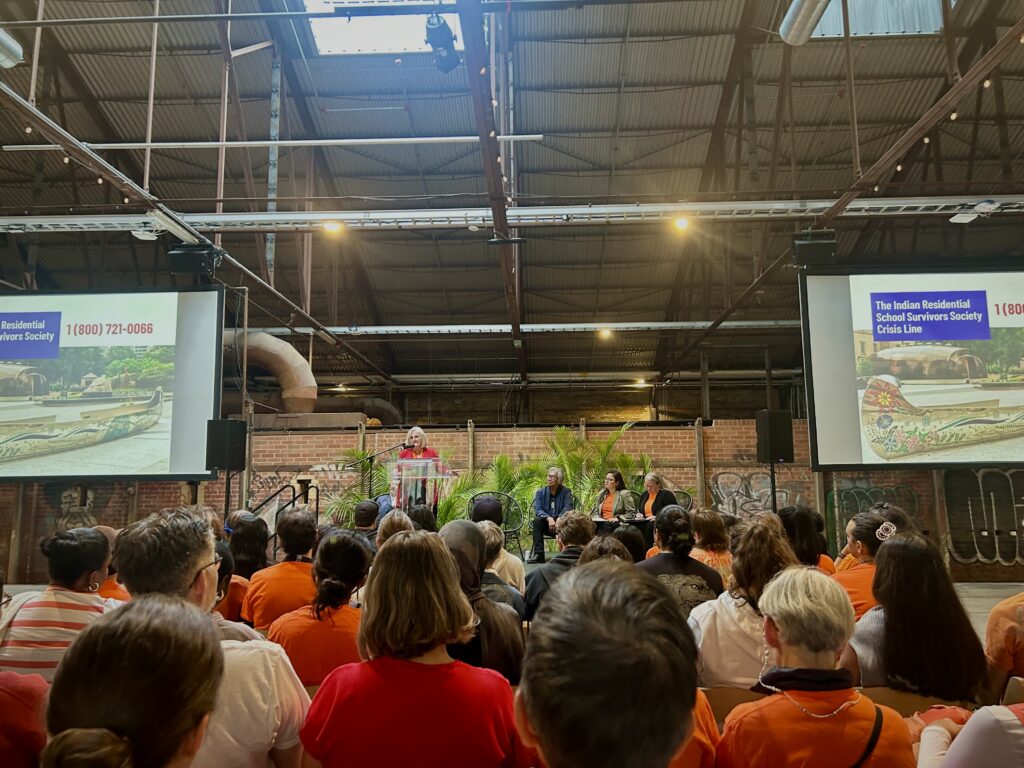
“The most comprehensive archive is set to be destroyed,” said Connie Walker, a Pulitzer and Peabody Award-winning investigative journalist and member of the Okanese First Nation, as she described the records. “The people committing the abuse are being protected by the destruction of the files,” said Walker at a Yellowhead Institute event, The Right To Truth: Protecting Indian Residential School Records.
In 2017, the Supreme Court of Canada ruled that more than 38,000 survivor records will be destroyed in 2027 on grounds of confidentiality.
The Indian Residential School Records (IRSR) project is an initiative led by Walker and lawyer Kimberly Murray, a member of Kanehsatà:ke Mohawk Nation and former executive director of the Truth and Reconciliation Commission (TRC). The IRSR project aims to preserve the documents that hold the truth of the events that took place in residential schools.
According to the IRSR website, “While living Survivors can opt to preserve their records, many remain unaware of this, or of the imminent deadline to do so, and there is no provision for family members to preserve records of those who have passed.”
Survivors of residential schools who were victims of abuse and wrongful acts were able to apply for compensation under the Independent Assessment Process (IAP). To make a claim under the IAP, claimants needed to submit an application that included sensitive, detailed and graphic descriptions of the abuse they experienced.
The Supreme Court allowed the records to be retained for 15 years from Sept. 19, 2012, the deadline to submit the IAP applications. During this period, survivors could choose to have their records preserved and archived at the National Centre for Truth and Reconciliation or choose to do nothing and let it be destroyed.
Walker says since the 2017 Supreme Court decision, only around 100 survivors have chosen to provide their records to be archived, but at the panel event, Walker and Murray said they believe the government has not followed their obligation to let survivors know that they can choose to preserve their records.
“The right to truth belongs to the survivors, their families and their communities,” said Murray. “We have the right to know who died, how they died, why they died and where they are buried.”
According to Walker, the IRSR project’s goal is to eventually return the records to the survivors, so they can decide what happens to their files.
“Survivors of families and communities have the right to have these truths preserved and protected,” said Murray, “so these atrocities never happen again.”
Murray served as Canada’s Independent Special Interlocutor for Missing Children and Unmarked Graves and Burial Sites associated with Indian Residential Schools from June 2022 to October 2024.
“Canada hasn’t implemented any of the 42 obligations that I issued in my final report,” said Murray, “it performs reconciliation and acknowledgment of Indigenous rights, but rarely integrates these rights into structures of governance or service delivery.”
The Permanent Peoples’ Tribunal released its final judgment on Sept. 30, 2026, ruling that Canada is violating international law by failing to investigate and prosecute crimes against Indigenous people.
Walker says preserving the records is crucial to pursuing accountability, especially with the 2027 destruction deadline approaching.
“As an investigative journalist, we’ll be reaching out to governments and seeking accountability,” said Walker. “I feel like in a lot of ways we’re at the beginning of this project, but it feels like there’s an urgency because of the timeline.”
The federal government has acknowledged the spread of residential school denialism and said it is working to counter misinformation and speakers at the event emphasized the importance of preserving survivors’ testimony and historical records as a way to combat misinformation about residential schools.
Murray says the records provide documented evidence at a time when denialism is growing.
“Deniers demand to see the evidence, to see the records, to see the proof, to see the bodies,” said Murray.
Stephen Kakfwi, a residential school survivor, former premier of the Northwest Territories and longtime advocate for Indigenous rights, spoke at the event about the lasting impact of his time in residential schools.
“They tell us to get over it but I know that I can’t get over it. I can manage it, but I can’t get over it,” said Kakfwi.

Reporter, OTR, F2026.

Reporter, OTR, F2026.