
AI disclosure statement: AI was used in the transcription of interviews that contributed to this article.
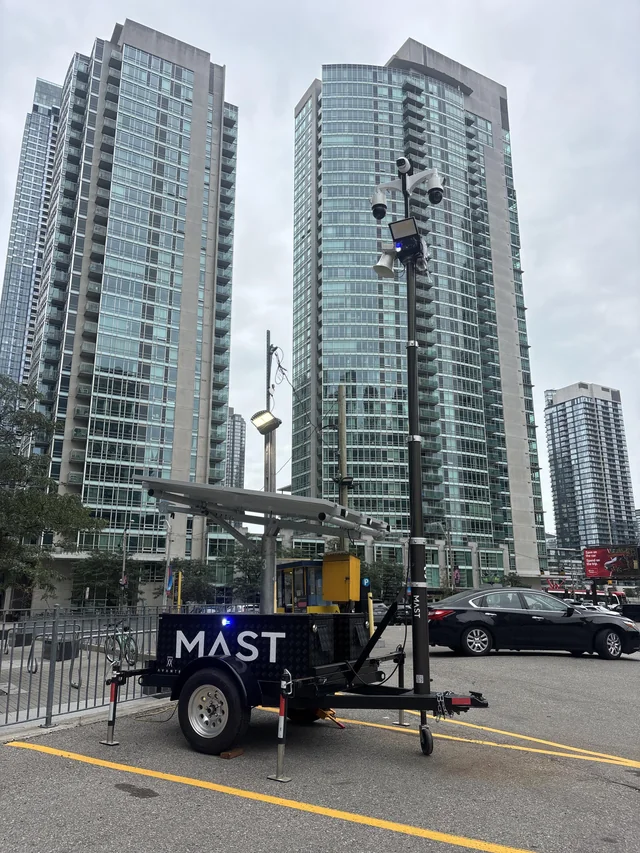
Avante Security, a private security company behind an AI-powered security camera first seen in Toronto last month has joined the Global Shield Network (GSN) according to a Nov. 2 press release. According to their website, the Toronto Police Service (TPS) has GSN partners in both the U.S. and European countries including the UK and Spain.
The security camera caused a stir on social media when first noticed on Spadina and Front streets in a private parking lot next to a condo building. Several others have been seen around the city according to other media reports. On Avante’s web page describing an installation that looks like the one on Spadina, they write that the “Mobile Automated Surveillance Tower”(MAST) cameras are “AI-powered,” able to to run facial recognition, scan for weapons, track license plates and more.
“The key takeaway from all of this for me is that we are at a tipping point, which is that surveillance technology,” said Dr. Tyne Sumner, a professor at Toronto Metropolitan University and an expert on surveillance and AI. “Historically, especially in the form of a camera, has been conceived as a device of record, and with the advent of AI, it turns that device into one of interpretation and then prediction.”
In an emailed reply from Frank Pietrobono, Avante’s vice president, wrote that the MAST cameras are typically set up in areas without reliable internet or power connections and have their AI capabilities set depending on the needs of the installation.
Listen to the whole story here:
Pietrobono wrote that the cameras are “not intended to conduct indiscriminate surveillance of surrounding residences or individuals going about their daily activities” and that “privacy and responsible use are paramount considerations.” According to Pietrobono, the use and collection of surveillance data is “managed in accordance with applicable privacy law requirements.”
Avante’s press release says they will have access to accurate information from different police and private GSN partners, be able to collaborate with these different police departments and companies and “create a force multiplier within the private sector to prevent crime and potential terrorist incidents.”
TPS has been talking about using AI in their work since 2022 when they approved a new Board policy that focuses on assessing “the use of new and/or enhanced Artificial Intelligence (AI) technology, and for previously approved AI technology that will be used for novel purposes or circumstances.” It also goes into detail about the need for transparency with such technologies and the need to “preserve the privacy of the individuals whose information it collects in line with ‘privacy by design’ principles.”
Sumner says this is the beginning of a new era of surveillance.“In the last 10, five years, there’s been a mass intensification of all kinds of AI enabled surveillance tracking,” Sumner said, referencing both the MAST camera and the recent arrival of Automatic License Plate Reader cameras across Ontario.
Even if the detection range and the coverage of the MAST cameras are limited, she says them just being visible has an effect.
“Even if that camera is completely useless, even if it’s not even capturing the other residents coming and going, it’s being weaponized as an apparatus of power to make people suspect or be suspicious that they might be on camera,” Sumner said. “Its function is to instill a certain kind of paranoia in people.”
Sumner said another issue with the system is an issue AI models generally have, which is that they recreate the biases of the people that have designed them and the society they are employed in.
The methods that the technology uses to identify and evaluate whether or not individuals are suspicious is not convincing to Sumner.
Pietrobono said via email that the facial scanning the MAST towers are capable of are video recognition and not facial biometrics, meaning they only detect people and don’t identify individuals.
“But the motive there is just the continual prediction of suspicious behavior,” Sumner said.
“We’re replacing, let’s call it, the presumption of innocence with the probability of suspicion… and that is deeply worrying because, as we know, the data about certain kinds of people that was in the LLM or in the database to begin with isn’t always correct or accurate.”
This data in particular is of concern to Sumner who worries about how this information is used by the private companies that hold it, who are then deciding how people are observed and tracked, which Sumner calls a transfer of civic infrastructures to private ones which may be more difficult to hold accountable in situations of misuse.
She said she wonders what the moment is when a few private cameras here and there suddenly become a public surveillance network.

Reporter, OTR, F2026.
