
AI disclosure statement: Otter.ai was used to transcribe the interviews.
Listen to the whole story here:
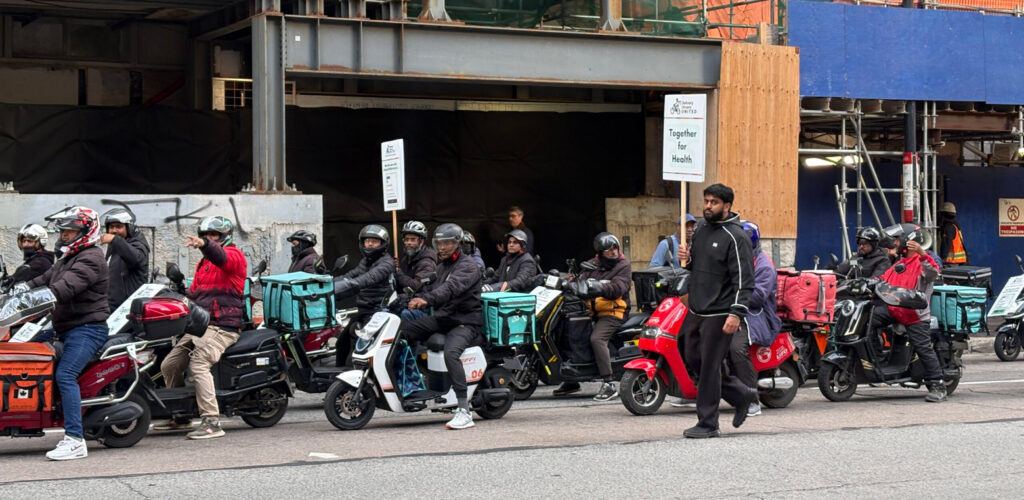
Hundreds of bike, e-bike and motorcycle delivery workers rallied in downtown Toronto on Monday afternoon, demanding better working conditions and fair pay.
Delivery Drivers United (DDU), a collective of delivery workers organized the rally, which began at Nathan Phillips Square at 2:30 p.m.
According to an Instagram post by DDU, the protesters’ demands included human dignity and respect, an end to random and unfair account deactivations as well as fair and transparent pay.
“Drivers say companies offer temporary incentives to attract workers, then reduce rates, leaving them working longer hours for less money,” said DDU in a press release sent to OTR.
Delivery drivers honked, held up signs and chanted “We want justice,” as other drivers and pedestrians expressed their support by honking or chanting.
Kelly Simpson, who was at the rally as a delivery driver said she met many other drivers facing similar challenges.
“It was really nice and uplifting for us to all get together and see that we’re like a community rather than just [independant] contractors, like Uber likes to call us. We’re really like coworkers,” she said.
Simpson worked as a full-time delivery driver and recently switched to part-time after getting another job.
“To be an employee [elsewhere], you get more stability, and you know that you’re going to be able to make rent and be able to afford food. With Uber, you’d never know. You could not get any orders that day, and then you’re kind of screwed,” she said.
Hassan Khan, a former Uber and Uber Eats driver, said vehicle maintenance costs sometimes left him and other drivers with no profit.
“I know a couple of drivers [who are] making $5,000 a month, but they are working [twelve to fourteen] hours a day. [Then] you take [gas prices and insurance] out, it’s barely like 2000 to 3000 because your car depreciates faster and all that,” he said.
Amy Cook, who started delivery driving after a divorce to make ends meet for her children, agrees.
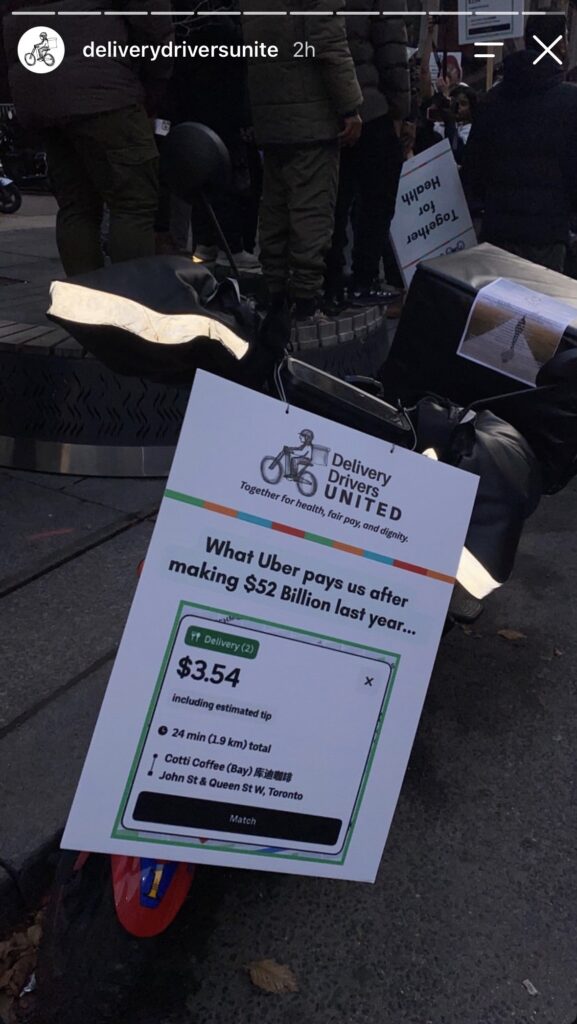
“I remember screenshotting some of the offers because you get an offer, [for] $5.80 and it includes the fee and the tip, right?… It’s 20 kilometers [for a] 45 minute [drive]… So I mean, it would equate to well below minimum wage,” she said.
According to a Job Banks Canada report from 2025, delivery drivers in Toronto make an average of between $17.95 and $30 per hour.
A spokesperson for Uber Canada told OTR News in an emailed response that delivery workers are guaranteed at least Ontario’s minimum wage which is calculated across each two-week pay period.
“Uber compares eligible earnings, excluding tips, against that guarantee and provides a top-up where there is a shortfall. Delivery people keep 100 per cent of their tips on top of the guarantee,” wrote the Uber Canada spokesperson in the email.
However, Simpson said the company only accounts for the time at which there is an active order.
“It doesn’t count for the time that you’re waiting for orders or anything, it’s only [counted] once you accept the order, and while the clock is running. You can be on your bike for eight hours and only get two hours of active time,” she said.
Ava Williams, a lawyer at The Biking Lawyer LLP, said anti-immigrant and anti-cyclist sentiments are also challenges delivery drivers in the city face.
“I was talking to one gentleman [on Monday who was] telling me how sometimes when he’s riding, people [in vehicles] will try and hit him or try and run him off the road, and I think that’s unfortunately a growing experience for not only e-bikers but cyclists all around in the city,” she said.
Khan, who immigrated to Canada 30 years ago, said it saddens him to hear about experiences like this.
“These people [are] coming from a different country. They’re driving bikes in the cold to provide for their families back home…They’re just normal people like [you and I] who are trying to work hard to put food on the table for their families to get a better future,” he said.
Simpson said she faces disrespect as a biker too.
“[People] like to yell at us while we’re doing deliveries, just random curse words. Then at restaurants, sometimes you can go ten to 15 minutes without even getting acknowledged by someone,” she said.
According to Williams, The Biking Lawyer LLP started as a way to advocate for cyclists.
However, after noticing increased frustration toward delivery drivers, the firm started to host “Know Your Rights” workshops where they educate delivery drivers about “having legal e-bikes versus illegal e-bikes, lithium batteries, [etc].”
In May, 2026, Toronto City Council unanimously voted to back a provincial proposal to require registration, identifying vests, and insurance for e-bike delivery workers.
Cook said working in delivery has shaped her perspective on the industry.
“As an Uber Eats consumer, I had no idea that these guys were paid so little. So my attitude towards them when I get back to being somebody who orders food and doesn’t deliver it, [will] be a lot nicer…Going forward, I won’t use Uber Eats,” she said.
The story was updated on Nov. 7 with three sources, DDU’s press release and Uber Canada’s statement. Two sources’ names have been changed in this article due to their fear of losing their job, something we did not want to put at risk. Specifically, the names Amy Cook and Kelly Simpson are aliases in this story.

Reporter, OTR, F2026.
