AI disclosure statement: AI was used to transcribe interview audio files, and Grammarly was used for spell-check and grammar-related errors
Listen to the whole story here:
One year after the Ontario government banned speed cameras across the province, residents and experts are pushing to have the cameras restored.
“We know that safety is primarily a function of speed, so the higher the speed of a collision, the more high the likelihood of death or severe life-altering injury,” said Jess Spieker, a spokesperson for Friends and Families for Safe Streets (FFSS), a Toronto-based advocacy group.
Spieker was struck by a car in 2015, leaving her with spinal cord and brain injuries. FFSS was formed by victims and their loved ones affected by what they refer to as road violence.
“They’re not accidents, they’re results. They’re results of the way we design our streets and the way we design our vehicles and the way we design our laws. And those are all decisions that were made by adults who should know better,” said Spieker.
The removal was part of Bill 56, which passed through the Ontario legislature on Nov. 14, 2025. According to the provincial government, the automated speed cameras were not sufficient in slowing down speeding drivers and primarily functioned as a revenue generator for municipalities.
In a 2025 study led by The Hospital for Sick Children and researchers at Toronto Metropolitan University, researchers found that speed cameras do slow down drivers and that automated speed enforcement cameras reduced speeding by 45 per cent across 204 Toronto locations between 2020 and 2022.
“Every single peer-reviewed paper on this topic says that they are highly effective,” said Carrie Mitchell, an associate professor in the University of Waterloo’s Faculty of Environment.
According to the Toronto Police Service, pedestrian deaths in Toronto have increased by 22 per cent from this time last year.
Theo Markulin-Schmidt, a Toronto resident, said drivers often carry highway speeds onto nearby residential streets in Toronto’s west end.
“I think people definitely are getting off the highway and kind of keeping the pace of them being on the highway,” Markulin-Schmidt said. “I think either having more speed cameras reinstalled… or having traffic-slowing measures like the road being slightly redesigned so that people have to go slower.”
Mitchell said Ontario has a longstanding car-centred culture that prioritizes drivers over other road users. “We have a motor-normative culture,” she said, simplifying the concept as “a nice academic term for car bias.”
She said this attitude has existed for decades, with speed limits often treated as suggestions rather than rules.
“If the speed limit is 40 and you go 39 or 40, you won’t be ticketed. The problem is that in Ontario, we have a culture of speeding and of breaking this rule. A lot of people think of it as a guideline,” said Mitchell. “It is not a guideline. It is a law.”
The speed cameras on Parkside Drive in Toronto’s west end have been the center of controversy. Parkside Drive is located directly off of the much higher-speed Lakeshore Boulevard and Gardiner Expressway, causing drivers to often drive it at highway speeds. Before the ban, one of the cameras was repeatedly vandalized, even being cut down multiple times.
“It’s almost immediately, as soon as the cameras were gone, speeding went up, and it’s continued to go up since then. It’s over a 500 per cent increase as of the latest numbers,” said Faraz Gholizadeh, co-chair of community group Safe Parkside. “To be honest, it didn’t feel safe even while the camera was there.”
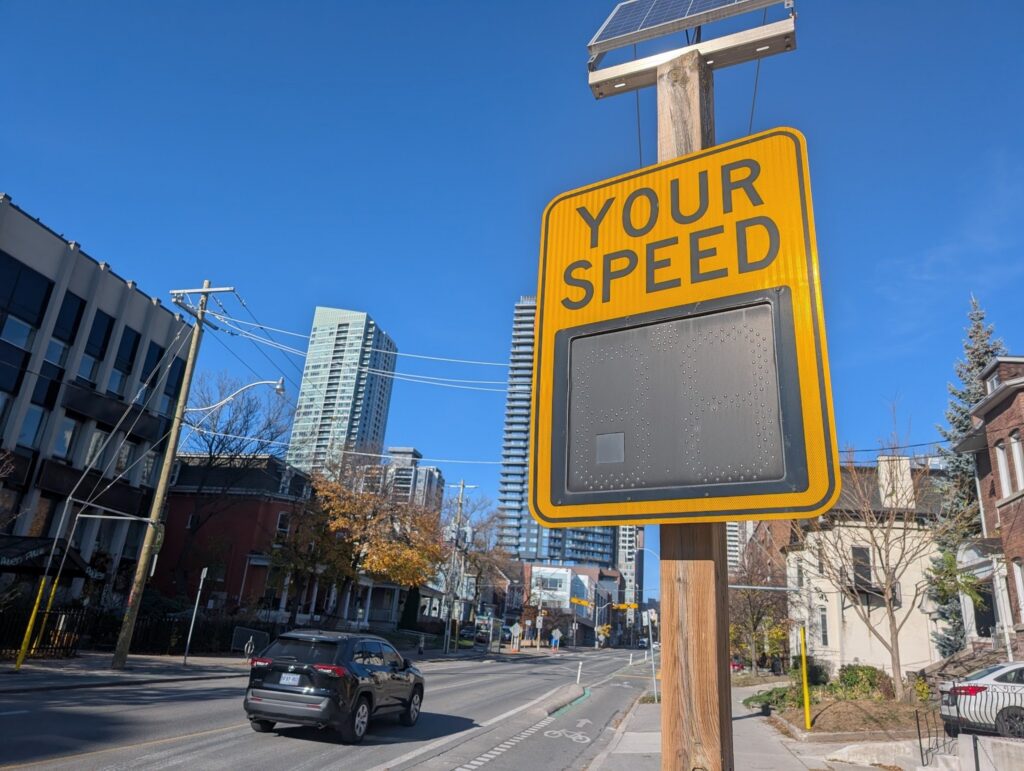
Data collected from the radar speed sign on Parkside Drive shows that the number of drivers travelling more than 60 km/h has increased 528 per cent since October 2025, while the number of people exceeding the 40 km/h speed limit on Parkside has increased 188 per cent in the same time period.
Gholizadeh said road safety has long been a concern on Parkside Drive and that speeding problems have continued since the cameras were removed.
“There have been some serious crashes since the camera was removed just a couple months ago. In August, there was a car that took out a hydro pole [and] knocked power out in the community for the entire day,” said Gholizadeh.
John Hanchar, another Toronto resident, said, “ I always get a little bit nervous at some of the bigger intersections, especially with people turning right really fast to get through the lights. I have almost been hit at the corner of Bloor and Dundas West near where I live.”
The province has suggested implementing other traffic calming measures in place of speed cameras, including speed bumps and raised crosswalks. Mitchell said although alternative traffic-calming measures proposed by the government can be effective, their success depends on several factors, including cost and implementation.
“You know, it’s not an either-or. It’s not ‘should we have speed cameras?’ or ‘should we have speed bumps?’ Let’s do all of these things at once because we care about people who are outside of cars,” she said.
Another proposed tool for slowing down traffic advocated for by FFSS is known as ‘complete streets.’ These refer to streets that have dedicated space for pedestrians, cyclists and drivers, and often feature narrower lanes and green infrastructure.
“[Speed cameras] are not intended to be there forever. They are a stopgap, and they’re the next best thing to building a safe, complete street,” said Spieker.
“However, the province has made it functionally illegal to build a new complete street anywhere in Ontario, because they’ve made it illegal to reallocate a car lane,” said Spieker.
OTR’s research shows that while not strictly illegal in every case, provincial legislation—through Bills 212 and 60—prohibits municipalities from removing car lanes without a specific provincial exemption from the Minister of Transportation.
“Until they start making changes to the design of the street, it doesn’t matter—even with the speed cameras returning, it won’t be as safe as it can be,” said Gholizadeh.