
AI disclosure statement: No AI tools were used in the production of this story
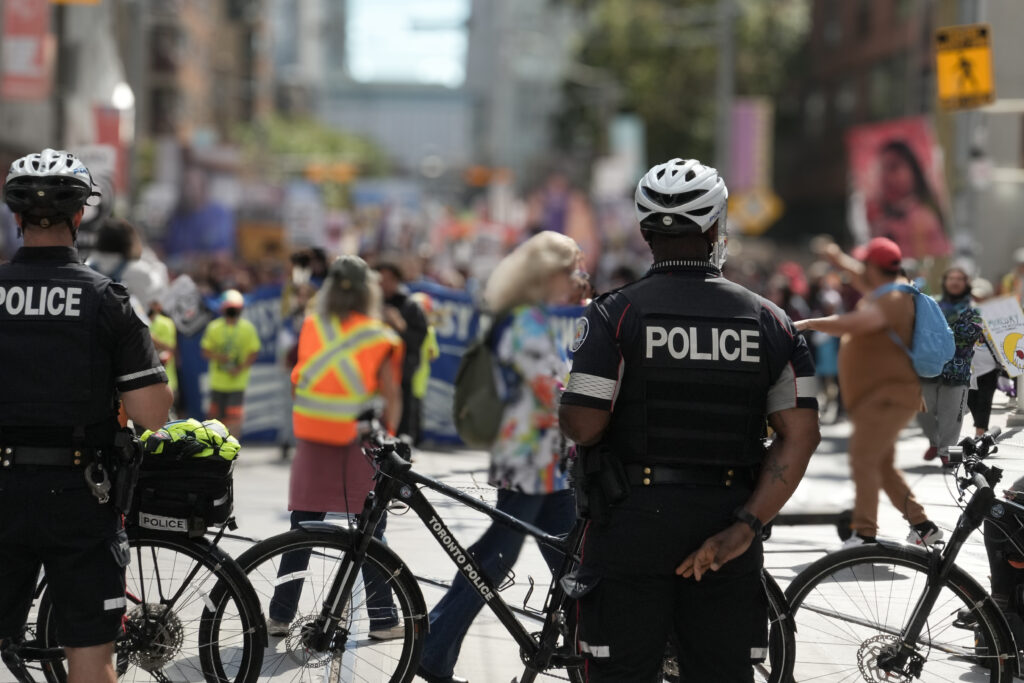
The Ontario government is considering implementing legislative changes that would limit protests outside “key infrastructure” like businesses, highways, community and cultural sites, and make protests in these places a provincial offence.
Sending up a test balloon, the provincial government has asked for feedback from the public through its public portal around what the implementation and enforcement of a policy like this would look like, including “making new arrest powers for police where there is a failure to comply with the duty to identify”
“We understand that protecting public safety is important, and we understand that, in some ways, the government’s request for feedback is in line with that. But what we see and what we know is that the police already have very broad powers to protect public safety,” said Anaïs Bussières McNicoll, director of the Fundamental Freedoms Program for the Canadian Civil Liberties Association (CCLA).
But these concerns don’t come out of the blue; in remarks to the Toronto Police Service Board earlier this year, Chief Myron Demkiw pointed out that “Since October 7, 2023, Toronto Police have made 524 arrests and laid 1,297 charges, in connection with demonstrations, protests, and hate-motivated offences.”
Policies on protests to protect public safety aren’t new to Torontonians, as last summer city council put a bubble zone bylaw into effect, allowing owners of “vulnerable institutions” to apply for a 50-metre exclusion zone. So for some, a new policy comes with a certain amount of skepticism, especially in quelling student voices and concerns.
“Any moves on the part of the province, or anyone for that matter, to curtail the ability of students and community members to protest peacefully is cause for concern and should be scrutinized,” said Sally Lee, interim co-executive director of the Toronto Metropolitan Students’ Union (TMSU).
On TMU campus, there have been several incidents involving student protestors being confronted by police and TMU’s own security. Outside a talk MP Evan Solomon was giving on campus, student protestors were allegedly assaulted and escorted out of the area by TMU security, which was followed less than a week later by a rally and more intervention from TMU security. Former head of the federal NDP party, Jagmeet Singh, was interrupted on campus by protestors in 2024.
More protests are planned on campus and off-campus in the next few months, and the proposal raises uncertainty about what the future of protest looks like in Ontario and what the trade-off for public safety looks like, when limits are placed on protesters’ ability to make their voices heard. “If I hold a protest in my living room, I’m not disturbing anybody, but I’m also not being heard by anybody,” said McNicoll.

Reporter, OTR, F2026.
