
AI disclosure statement: Quillbot was used for grammar checking.
Listen to the whole story here:
When scrolling through a restaurant’s menu or ordering food online, customers usually want to see pictures that resemble the food they’re expecting to get.
But as restaurants look for new ways to market their food, some are turning to artificial intelligence (AI) to create images for their dishes.
A new report from the U.S.-based National Restaurant Association found that over 25 per cent of restaurant operators are using AI-related tools, with marketing being the most common use.
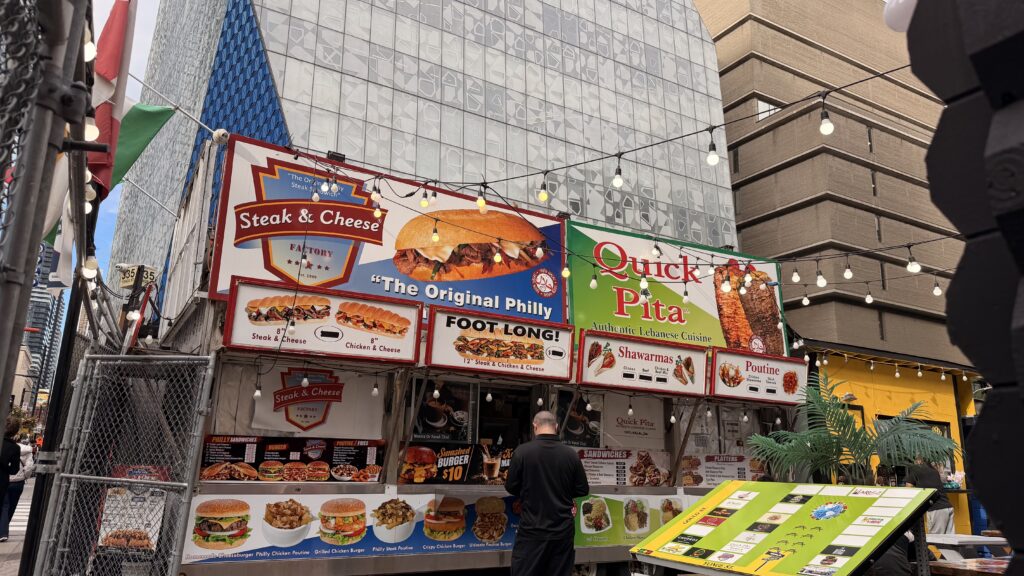
“They show the customer exactly what they’re getting,” said Khalil Assaad, owner of Steak and Cheese Factory. “It’s a great marketing tool.”
Assaad said AI makes it easier and cheaper to create promotional material while helping the restaurant keep up with current trends.
“Everybody’s doing it,” he said. “Why not us?”
But not every restaurant owner has had the same experience with AI-generated images.
“They want to see the original pictures of what they will get,” said Yulduz Murad, co-owner of Savors.
Murad said the restaurant originally turned to AI because they only had two days to prepare their promotional material before opening. With so little time to hire a professional, they decided to use ChatGPT instead.
But after hearing customer feedback, Murad said the restaurant decided to replace the AI-generated images with professional photos.
“When I show them the real pictures of my products, they say, ‘Oh, this looks much better than AI pictures,’” she said.
For aspiring graphic designers, the growing use of AI in restaurant marketing could also mean less demand for their work.
“I think most businesses and companies are utilizing AI because it’s less costly to do so rather than hiring a graphic designer,” said Shouq Almehairbi, a graphic design student at TMU.
Almehairbi says AI-generated designs can also result in mistakes, including “wrong addresses or missing key information like date and time of an event” or even “making up entire products they don’t sell.”
“We are able to do something AI can’t, which is getting information correctly,” she said.
“There is the human aspect to it. There is the human touch,” said Danny Mikhail, an early-career photographer who entered the industry two years ago. “AI will never be able to have that human emotion and feeling in it.”
He says AI-generated food images can also look unnatural and take away from the effort that goes into professional food photography.
“I’ve seen some beautiful work with food photography that AI will never be able to do,” he said.
While AI-generated images may not be enough to stop customers from going to a restaurant, some still notice when they are being used.
“It’s not like I would see it and walk out of the restaurant,” said Huma Naim, a fourth-year biology student at TMU. “But it is something I make note of.”
Naim said even though she’s not a fan of restaurants using AI for their promotional material, she understands that some businesses may not have the resources to create it themselves.
“I do feel like if you’re taking care of an establishment, you should be able to ask your workers if they can put their own creativity into the restaurant and their advertisement,” she said.

Julia Pen is a fourth-year journalism student and storyteller for, On The Record, fall 2026.