
AI disclosure statement: AI tools were used for the audio transcripts and grammar/spelling check.
Listen to the whole story here:
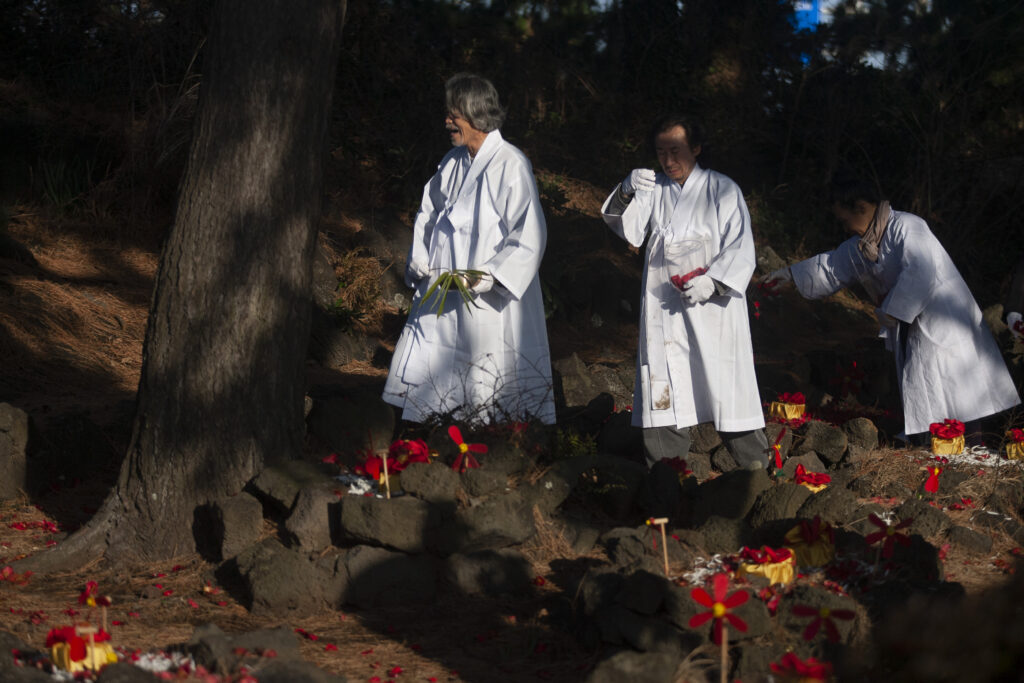
A special screening of Children of Pongnang brought together students, scholars, and community members at Palmerston Library Theatre. The film commemorated the spirits of 818 young children who were killed in the Jeju 4.3 incident and confronts state violence, memory and mourning, centering on the Neobeunsungi Baby Tombs in Bukchon-ri, Jocheon-eup, Jeju. The director described Children of Pongnang as a film that ‘calls the names again’ of the children who lost their lives during Jeju 4.3.
Jeju 4.3 refers to an armed uprising on April 3, 1948, on Jeju Island, South Korea, followed by armed conflict and a government crackdown that killed more than 15,000 residents.
The special screening was organized in connection with the international workshop “Children in Historical Precarity: War, Coercion, Migration, Disaster and Survival — Global Asian Literature and Visual Culture,” held at York University on Oct. 2 and 3.
During the workshop at York, Kim Sung-nae, an emeritus professor of religious anthropology at Sogang University, described the film as a kind of ‘cinematic funeral’.
“A mediated mortuary performance in which the camera, ritual objects, landscape, surviving witnesses, performers, and spectators participate in reconfiguring the relation between the living and the dead,” she said.
Hong Kal, an associate professor at York University and the organizer of the workshop, explained that the project began with concerns about how children, who are among the most vulnerable populations during crises such as war, are not protected but are instead more easily exposed to violence and become some of its greatest victims.
“Although the historical contexts are different, the fact that children were confined in residential schools and subjected to a history of killings and violence is not only an issue in Asia, but violence that also occurred in Canada. The issue of reconciliation is still ongoing, which makes it highly relevant,” she said.
Attendee Jiyeon Ko was born in Jeju. Her father lost his father and his sister during the Jeju massacre.
“Thinking quietly about why my father suffered from depression throughout his life, I realized it was because of 4.3. I kept crying,” she said.
She said that despite being from Jeju, she did not learn about the incident until she was 40. “In one village, every house had a memorial ceremony. The children would run around outside, and it was just fun, but no one ever told us about what had happened.”
Director Sa Eugene shared the meaning of the film through a written interview.
“In Jeju, there is an expression called ‘Gamegi Moreun Sikge,’ which means ‘a memorial ceremony held without even a crow knowing. . . I wanted to show that someone still remembers the children who tragically ended their lives at such a young age and that we are still with them” he said.
“There was a time when it was difficult even to openly hold memorial ceremonies for the children who died. The survivors would secretly place a bowl of water for them late at night. Nearly 80 years have passed since Jeju 4.3. Shouldn’t we now also mourn the children?” he said.
Kim explained that, in the case of Go Wan-sun, who appears in the film, she did not report her younger brother as a victim for 70 years because of guilt.
“When hundreds of villagers were gathered in the yard of Bukchon Elementary School and a massacre was carried out, blood from a dead person got on Go Wan-sun’s hands as she lay close to the ground. Shocked, she cried out loudly, ‘Let’s go home.’ When her three-year-old brother, who was being carried on their mother’s back, also began to cry, a soldier, saying that the child was being noisy, struck the child’s head with the butt of his rifle. His skull was crushed, and he was taken to the Omppangbat massacre site, where he eventually died,” Kim explained.
Kim noted that the significance of the film lies in the dead children finally being recognized as social beings.
After the screening, Kal explained that the film is not just a documentary, but a kind of ritual for the deaths of children who were killed unjustly.
“It was difficult to understand the film itself, but when I heard that it was a way of mourning, it made sense,” said another attendee, Jae Hwan Lim.
Director Sa said the form of mourning is not what matters most, but rather remembering and mourning together the children whose deaths had not been properly mourned for decades.
“I hope the memory does not end in Jeju,” he said. The special screening in Toronto, he added, would not only serve as a catalyst for bringing Jeju 4.3 to the world, but also provide an opportunity for people to think together about peace for children who are dying somewhere in the world even at this moment.
Children of Pongnang is scheduled to have a series of special screenings through 2027 in South Korea.

Reporter, OTR, F2026.
