
AI disclosure statement: No AI tools were used in the production of this piece.
Listen to the whole story here:
Recent stories about the possible hazards of ever more powerful artificial intelligence have raised alarm bells about humanity’s ability to keep up with the technologies it develops, including quantum computing. Quantum technology promises to tackle some of society’s toughest issues, such as improving medical imaging, finding new materials, and optimizing all logistics, but as researchers race to develop increasingly powerful quantum systems, another question is emerging: can society keep pace with the risks that may come with them?
“I mean of course. Just like any other kind of technology past or present, there is always the potential for dangerous innovations,” said Carina Millsech, a third-year physics University of Toronto (UofT) student who attended the conference. Millsech pointed out that the security concerns surrounding quantum computing are not necessarily unique to the technology itself.
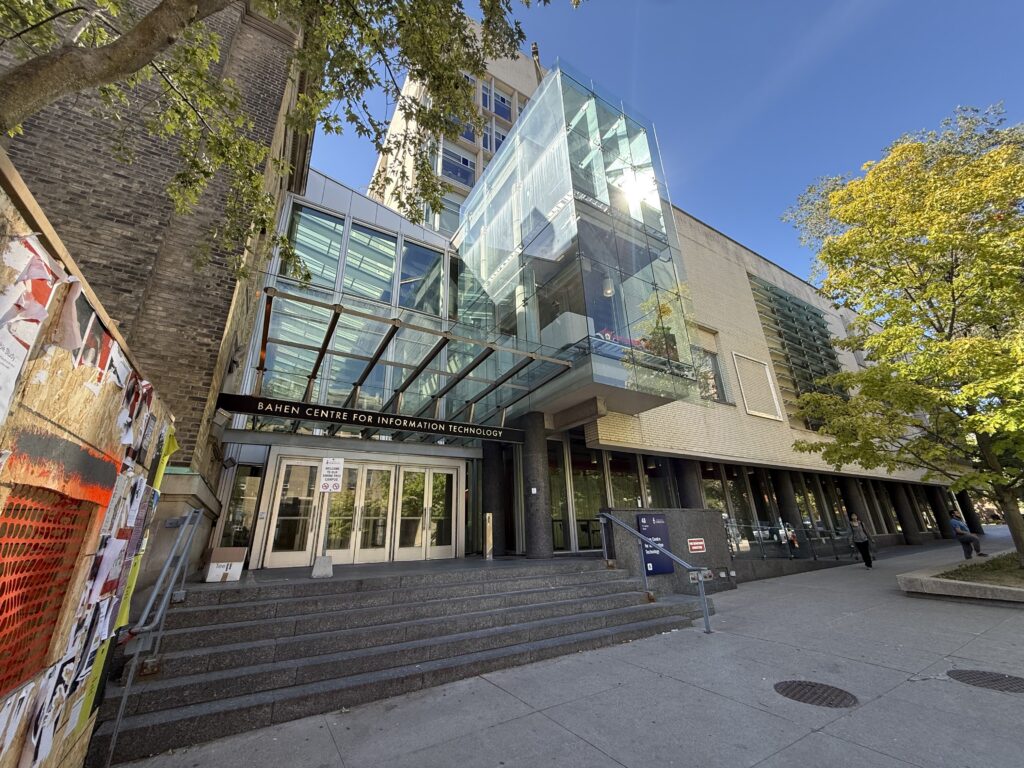
The Q-SITE Quantum Conference was held on Sept. 26 and 27 at the UofT’s Bahen Centre for Information Technology.
Quantum Science, Information, Technology and Engineering, also known as Q-Site, is an event that brings together students, researchers and industry professionals through technical talks, panels, networking opportunities, a hackathon and a student poster session. According to the website, the goal is to expose students to the growing number of fields where quantum technologies could be applied while also informing them about the dangers.
Avi Goldfarb, the Rotman Chair in Artificial Intelligence and Healthcare at the University of Toronto, has similarly emphasized that the technology’s potential needs to be considered alongside its risks. “While it’s not clear exactly when these machines will be available and if they’ll be able to operate at the speeds we envision, quantum computing’s potential impact is too big to ignore. It’s worth thinking about and supporting right now,” Goldfarb said.
The concern is already being addressed by the Canadian government. The National Research Council (NRC) of Canada launched its 2026–2028 Quantum Safe Technologies Initiative to address emerging cybersecurity threats associated with quantum computing. The NRC warns that sufficiently powerful quantum computers could eventually break encryption protecting sensitive financial, military and health information. It also warns that attackers could collect encrypted data today and attempt to decrypt it once more powerful quantum computers become available, a strategy known as “harvest now, decrypt later.” The agency says such attacks could threaten critical infrastructure, national security, data privacy and essential services.
Among the speakers was UofT professor Peter Love, who offered an apt description of the technology’s potential:
“You can virtually simulate anything on this planet with a quantum computer.”
MIT professor Paola Cappellaro’s presentation, “Quantum Sensors: Where Quantum Meets the Real World,” focused on how quantum mechanics can be used to create highly sensitive measurement devices. Her research discussed applications ranging from medical imaging and biological sensing to energy, navigation and mineral exploration.
The potential benefits of these applications, however, come alongside broader questions about how the technology should be developed and adopted. An expert panel report from the Council of Canadian Academies emphasized the need to consider both sides of that equation. Eric Meslin, then president and CEO of the Council, said that “Canada’s quantum readiness depends on our deepest consideration of the risks and benefits these technologies pose.”
Cappellaro highlighted work using quantum sensors to improve magnetic resonance imaging and potentially achieve greater spatial resolution. She also discussed nanoscale sensors that could detect biological material, including DNA and RNA, and smaller magnetic sensors that could potentially be used to measure activity in the brain.
One potential application is medicine. Quantum sensing could eventually help researchers detect biological signals at scales that conventional technologies struggle to reach, potentially opening new approaches to medical imaging and diagnostics. Cappellaro also discussed research involving the detection of signals from the brain using much smaller, more portable sensing equipment.
But the potential benefits come with a significant security question. A March 2026 report from the Centre for International Governance Innovation found that quantum computing could bring major advances in areas such as optimization and economic modelling, while also creating risks for existing encryption and financial systems. The report’s authors describe quantum technology as changing the landscape through both “risk and opportunity channels,” arguing that countries need to prepare for its security risks while making use of its potential benefits.
That distinction could become increasingly important as quantum computers become more capable. Technology that can perform calculations beyond the practical capabilities of today’s classical computers could also challenge existing approaches to cybersecurity.

Reporter, OTR, F2026.
