AI disclosure statement: In producing this story I used Quillbot for Grammar checking.
Listen to the whole story here
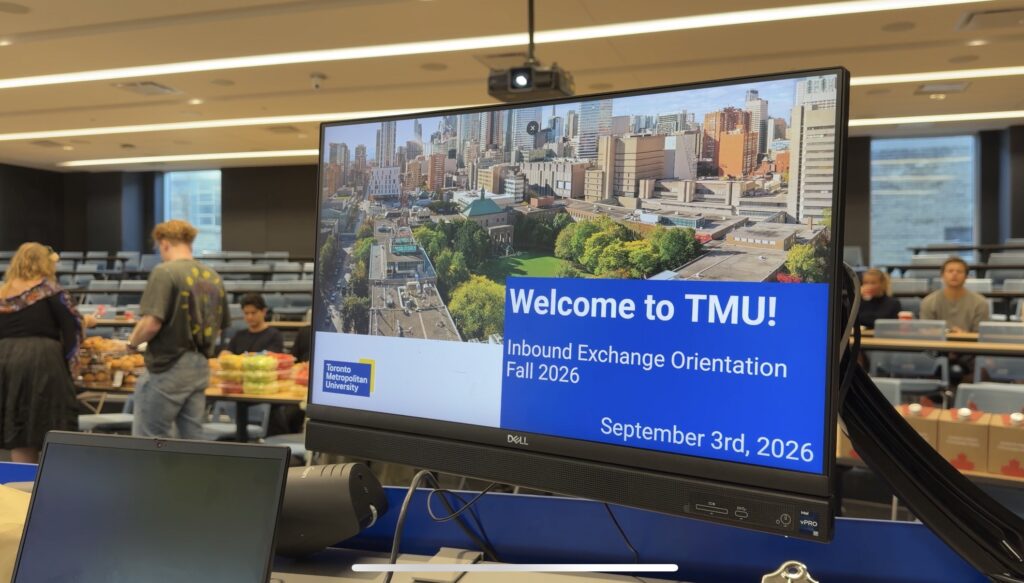
At Toronto Metropolitan University (TMU), this fall semester the university welcomed 192 inbound exchange students, a 19 per cent increase since last year, according to internal data from TMU Global. This increase comes as Statistics Canada’s latest report from May shows that full-time international student enrolment has declined by 29 per cent between the 2023-2024 and the 2025-2026 school years.
TMU Global is the department responsible for managing international recruitment, student admissions, global learning programs, and international partnerships.
“Toronto is a cool, diverse, metropolitan English-speaking city. Being a Londoner, I have very high standards, so I wouldn’t go somewhere I didn’t think was cool enough,” said John Conway, an exchange student from the University of the Arts London, who originally wanted to study in New York. After that option did not work out, he chose Toronto.
The decline in international enrolment over the past three school years follows a series of federal measures introduced to limit the number of international students in Canada. In January 2024, the federal government announced a two-year cap on international study permit applications. That year, the cap resulted in approximately 290,000 approved study permits, which was a 41 per cent decrease from 2023.
As part of the new policies, most study permit applicants were also required to obtain a provincial or territorial attestation letter, known as a PAL or TAL, confirming that they fell within the number of students allocated to that province or territory.
“When the requirement was first introduced, exchange students were not initially exempt, which created some challenges for us,” said Ashley Ruffin, TMU Global’s academic advisor. “We had to tell some of our full-year exchange partners that we could only support semester-long exchanges because we couldn’t guarantee the PAL their students would need for a study permit.”
A year later, the federal government created an exemption for inbound exchange students, removing the PAL/TAL requirements to preserve reciprocal exchange agreements and opportunities for Canadian students to study abroad.
“Exchange is really important to an individual student; it is also a really valuable piece of a relationship between institutions,” said Sara Berman, executive director of global engagement and partnerships at TMU Global. “Exchange…can also lead to faculty members engaging with each other, developing additional high-impact research opportunities, especially around our research focuses like city building, health, and sustainability. That’s why we look at who our partners are for exchange because we try to match institutionally,” she added.
Berman says that there are several factors that can be driving the increase in inbound exchange, such as the removal of PAL/TAL requirements, strong demand for study abroad at partner institutions, and established reciprocal exchange relationships.
Leanne Stillman, executive director of international student enrolment education at TMU, says international enrolment is also shaped by changes happening in the world, not just policies introduced in Canada.
“It’s not just Canada that has restricted international students; governments in the US, UK, New Zealand, and Australia have also introduced a variety of restrictions, including enrolment caps, higher proof of funds, and stricter entry criteria,” Stillman said.
A resulting trend Stillman has noticed is a growing interest in TMU from students in the U.S.
“One of the countries that we’re seeing a really positive shift from is the United States, whereas historically we might have seen more students enrolled from the Middle East or India or some other regions,” she said. “We’ve always had students from the US but not in the same level of interest in applications.”
While Canada created an exemption for exchange students, international and exchange students in the U.S. have faced a different set of policy changes.
In early 2025, the U.S. implemented several changes affecting prospective international students, including expanded online screening for student and visa applicants, as well as new visa restrictions affecting nationals of certain countries, such as Cuba and Venezuela.
According to NAFSA: Association of International Educators, new international student enrolment in the U.S. fell 17 per cent in fall 2025.
These restrictions have continued into 2026. NAFSA has reported visa bans, limited and delayed visa appointments for international students, as well as priority visa processing for FIFA World Cup ticket holders.
Amid the changing international environment, Seagull Institute, a Chicago-headquartered international education provider, brought its annual summer program to Toronto this year.
According to its website, the institution is a third-party provider that organizes short-term international programs for universities.
“Over the past year, we have seen some of our international university partners reassess where they want to bring their students, taking into account the broader international environment as well as institutional and practical considerations. This led us to explore alternative destinations with some of our clients,” said Jonathan Broutin, founder and CEO of Seagull Institute.
For students coming to TMU on exchange, some of the same considerations shaped their decisions.
Roy Albinson, an exchange student from Linköping University in Sweden, said they wanted to study somewhere outside of Europe and experience a new continent. Of the partner universities available to them, Albinson said Toronto stood out as an English-speaking city that was relatively easy to apply to.
“I was a bit worried at first, though, that Canada would be closer to the political climate and safety of the U.S., but after some research I found that wasn’t really the case and that they had quite good statistics,” they said.
Jade Harm, an exchange student from Wageningen University and Research in the Netherlands, also ruled out the U.S. when choosing where to study.
Harm said she had been looking for an English-speaking destination outside of the U.S., New Zealand, and Australia. When asked whether political considerations influenced the countries she considered, she pointed specifically to the Trump administration.
For Seagull Institute, its first program in Toronto has opened the door to returning to the city.
Broutin said feedback from both students and the university was positive, pointing to Toronto’s diverse culture, welcoming atmosphere, and access to business professionals as highlights of the experience.
“If they want to have an international experience within a city that will cover the whole continents across the world, Toronto would be it,” he said.

Julia Pen is a fourth-year journalism student and storyteller for, On The Record, fall 2026.