
Listen to the whole story here:
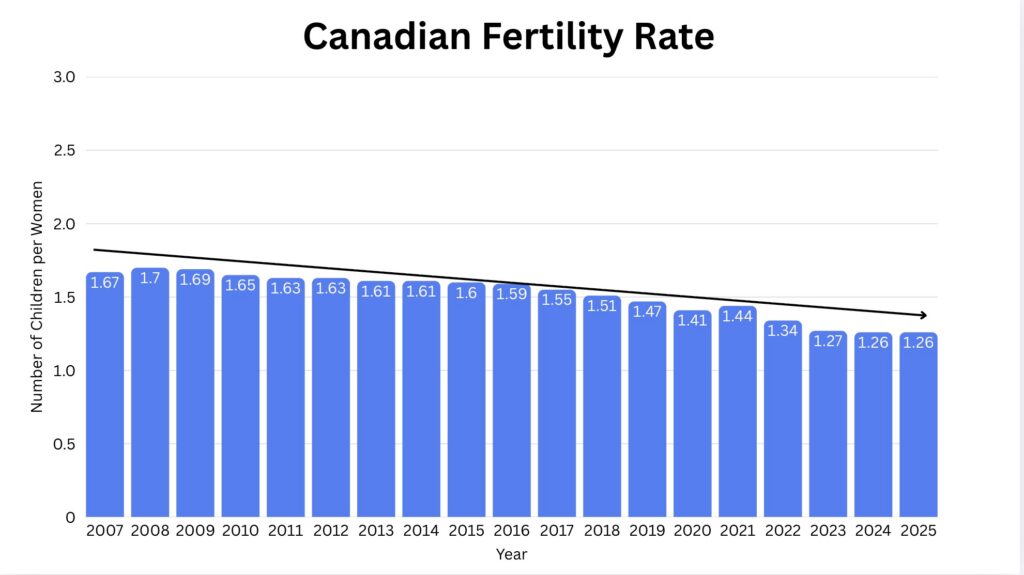
Canada’s fertility rate remained at a record low in 2025, with an average of 1.26 children born per woman, according to Statistics Canada. The rate has been declining since 2009, following decades of higher fertility after the post-war Baby Boom. The decline became more pronounced between 2017 and 2023, before slowing in 2024 to 1.26 and staying there for 2025.
The latest figure is the same as in 2024, when Canada recorded its lowest fertility rate on record. While the rate had been falling for years, the continued decline has brought more attention to what fewer births could mean for Canada’s population and future and why people are having fewer children.
“The reproductive age span has – in a way – shortened, because people are waiting a little bit longer to have their first baby,” said Nigel Pereira, a clinician-investigator and associate professor of obstetrics and gynaecology at Mount Sinai Fertility and the University of Toronto. “Therefore, the total number of babies in the reproductive age span has also dropped significantly. But in general, I think all over the world … we’re realizing it’s becoming more expensive. So a lot of couples have to make that decision, because babies are ultimately expensive.”
“The workforce, the government, has to be aware that what is happening in that particular situation (going on maternity leave) is for the long term benefit of the entire country. Whether that’s affordable dayscares, affordable formulas, diapers, all of those things, it’s extremely important.”
According to an RBC report from February, the cost of raising a child in Canada “is roughly $293,000 from birth to age 17.”
Pereira also pointed to workplace pressures surrounding maternity leave, saying some businesses may view an employee’s absence as an inconvenience because they have to find someone to cover the position. The fear of upsetting an employer or facing consequences for taking time off can add another layer of pressure for women considering having children.
The so-called “motherhood pay gap” has been studied for decades, including by University of Toronto researchers who in 2025 estimated a 49 per cent average drop in earnings for mothers in the first year after a birth.
To keep a population stable without relying on immigration, a country requires a replacement fertility rate of 2.1 children per woman. With Canada’s total fertility rate hovering at 1.26, the country is well below that threshold.
“There’s a distinction between declining fertility rate and then total population. The population has steadily increased, but it’s all due to immigration in more recent times,” said Dr. Usha George, a professor in the School of Social Work and the former director of the Toronto Metropolitan Centre for Immigration and Settlement (TMCIS) at Toronto Metropolitan University.
“So, if you were to say ‘how do we maintain our population’ you can’t depend on immigration but we also need to take care of some of the internal stuff […] For example, there are major factors why people are not having enough or limiting the number of children they have because of expenses and all of those kinds of things.”
While the effects of a declining birthrate may not be felt immediately, the demographic impact could become more apparent over the coming decades as fewer births contribute to a smaller working-age population.
“Economically, low fertility is associated with a shrinking and aging labour force, which could include skill shortages,” said Bruce Newbold. Newbold is a professor at McMaster University who studies population issues in their relation to migration, immigration, health, and aging. “Socially, there is the risk of greater isolation, increased stress on families to provide care.”
According to a report from the C.D. Howe Institute, Canada needs to plan for a future “to manage absorptive capacity to avoid overburdening housing, healthcare, and public services.”
Newbold agrees with this long-term thinking. “From a national perspective, population aging will likely mean slower GDP growth as the labour force shrinks. Business and industry will need to adapt to ensure productivity improvements through technology adoption and to offset labour shortages.”

Reporter, OTR, F2026.
