AI disclosure statement: Grammarly and Otter A.I. were used in the production of this piece.
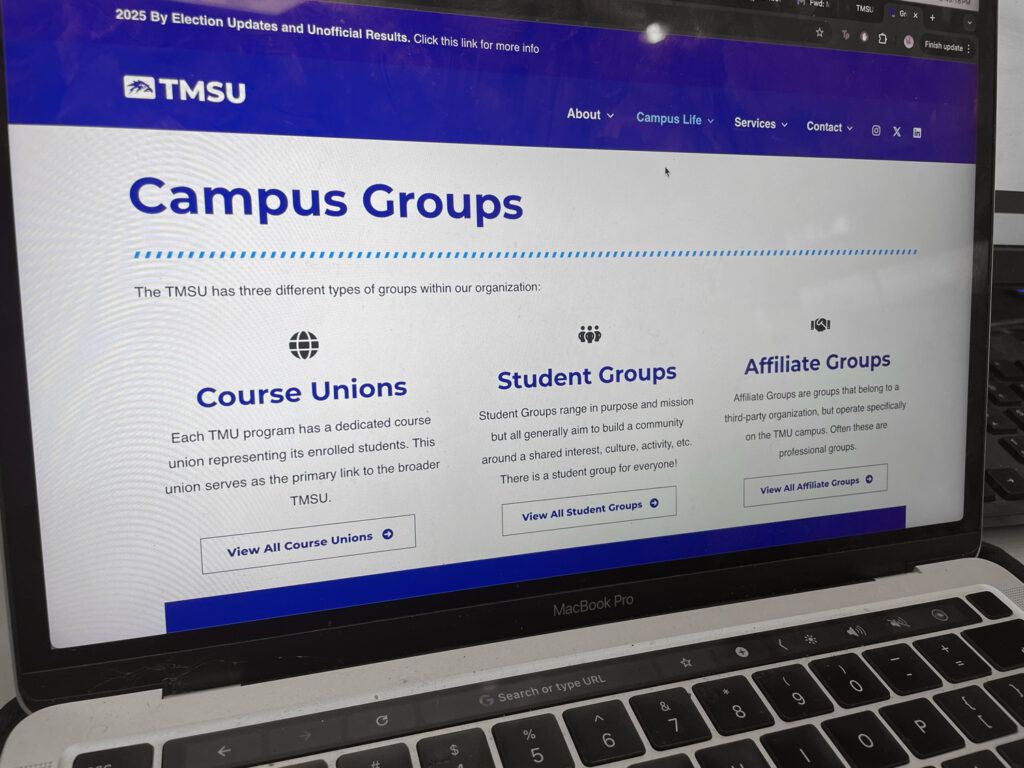
The Toronto Metropolitan Students’ Union (TMSU) has reduced base funding for student groups, clubs, and course unions from $1,500 in 2025 to $600 in 2026 (it was $1,200 for the 2024 school year).
Per the campus group code of conduct, TMU student groups may not charge membership fees, and must operate on a not-for-profit basis. So they primarily rely on base funding from the TMSU to cover general operational costs, such as posters, promotional materials, and training for executive team members.
These changes are due to the union’s budget not growing in proportion to the number of new campus groups and course unions, said Sally Lee and Scott Miller Berry, the interim co-executive directors at TMSU, in an emailed statement to On The Record News. The TMSU doesn’t currently have an elected body, after two nullified elections in winter 2025 and fall 2025.
“The board introduced this policy to provide the opportunity for due diligence in ensuring that these funds are actually going towards the operational needs of groups, which is what base funding is intended to support,” Lee and Berry’s email said.
Among the other changes, they said TMSU will now provide base funding annually rather than each semester. Student groups will also now have to apply for funding, providing details and the amount they need for operational costs, rather than receiving money automatically. Applications for base funding will close on Feb. 11 this year.
The TMSU also provides $6,000 in annual event funding, up to $3,000 per event, for academic, social, or cultural activities, which must be applied for, according to the emailed statement. It was also mentioned during the training sessions that due to funding delays for the 2025-26 school year, campus groups can apply for $6,000 for this winter term, with a Feb. 9 deadline.
Additionally, it was announced during the meeting that campus groups must renew their status each school year to remain active.
The new policies were updated on the TMSU website in early December 2025, but the change was announced at its mandatory training sessions for campus group executives, held on Jan. 28 and 30 in the Student Campus Centre.
Tobi Ibiyeye, a fourth-year civil engineering student and president of the student group Believers LoveWorld (TMU), said he was shocked to learn about the changes to funding at the session.
“I do think they could have announced it in a much better fashion, because it’s almost like mid-semester,” Ibiyeye said.
While he acknowledges these cuts could adversely affect student groups, he said he believes they could make executive members more financially responsible.
“I think there are positives, I think there are also negatives,” said Ibiyeye. “I’m sure there are some groups that would require more money than others, but I think you have to judge on a case-by-case basis.”
Running the Nigerian Students’ Association with the new funding cuts will be more challenging because of that, said its president and fourth-year biomedical engineering student, Ihinosen Ebhohimhen.
“We’re going to have to start doing more DIY stuff, which is obviously more strain on our team, where everyone’s a volunteer, and everyone is also already a student,” she said.
Because she runs a cultural group, Ebhohimhen says, expenses are high — the association must purchase cultural foods and other items that aren’t readily available in Toronto. While event funding is available, Ebhohimhen said she believes more groups will now be applying for it due to cuts to the base amount, meaning the likelihood of receiving it will decrease.
“[Student groups] are important, but it’s not like an essential service. If it’s so terrible, too hard, maybe they would dissolve. Maybe they would start doing less events,” she said. “In the long run, it will probably take a toll on people [for whom] student groups are really their main means of socialization.”
In their emailed statement, Lee and Berry said that having the $6,000 limit ensures that event funding can be equitably distributed among a greater number of groups.
“We appreciate the unique and exciting role of larger events and encourage groups for which this is a priority to start organizing well in advance to allow for creative ways to raise funds and provide ample time to reach out to other supporters beyond their student union,” their email said.