
Listen to the whole story:
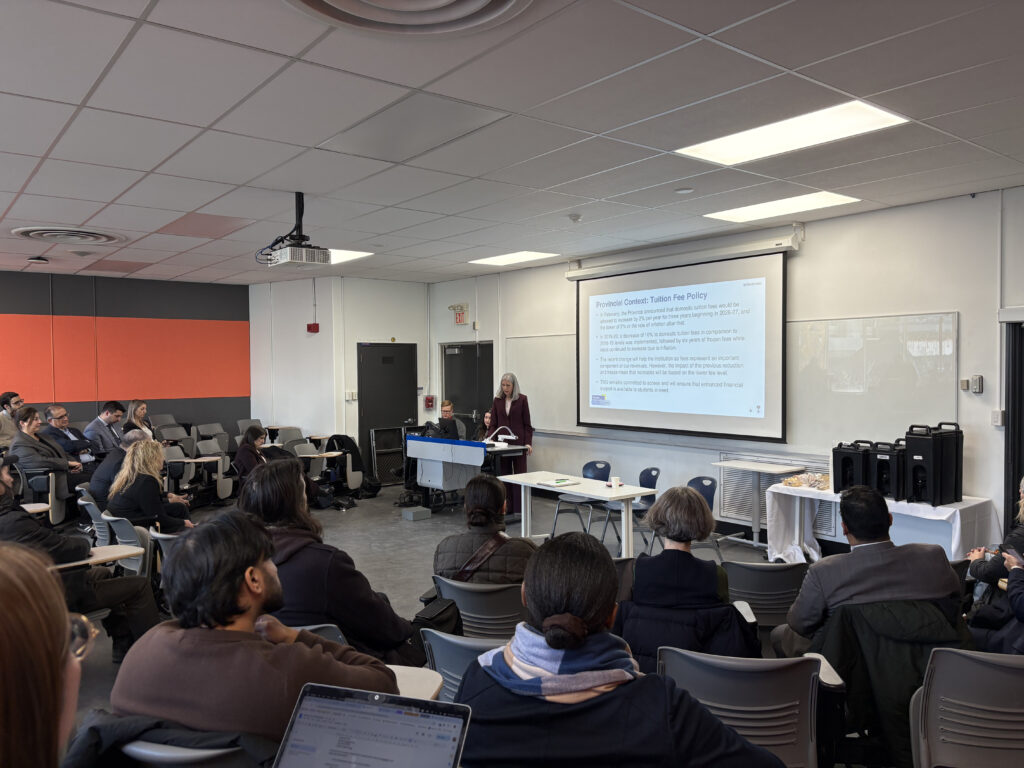
The lifting of a seven-year post-secondary tuition freeze was top of mind at Monday night’s budget town hall.
Toronto Metropolitan University (TMU) hosted the town hall with the publicized purpose of giving students, faculty and staff the opportunity to weigh in on priorities for the 2026-27 fiscal year.
“We are working within significant pressures created by years of frozen tuition and operating grants,” said Jim O’Brien, Director of University Planning, Budgets & Institutional Research.
Though TMU encouraged all community members to weigh in, some questioned how much influence they actually have.
Mohamed Lachemi, outgoing president and vice-chancellor of TMU, facilitated the discussion, explaining how the university’s planning cycle is guided by five principles: prioritize students, protect TMU’s core business of teaching and SRC, be fair and transparent, remain forward-looking, and conduct community-wide consultations.
TMU’s vice-provost of university planning, Kimberley McCausland, shared the biggest financial pressures the university is facing as it heads into the 2026–27 academic year. In 2019, Premier Doug Ford’s government announced a 10 per cent reduction in domestic undergraduate tuition at universities and colleges. After that reduction, the government implemented a multi-year freeze on tuition for domestic students, which effectively prevented universities from raising tuition for several years.
However, even though tuition revenue was frozen, inflation drove up the price of everything else. Lachemi explained that staff salaries increased, maintenance and utilities expenses all rose.
“When the Ontario government implemented a tuition freeze, they also froze our operating grants,” said O’Brien.
McCausland described how over time, this has created a financial gap between what the university collects in tuition and what it costs to operate. TMU’s senior administration proposed a two per cent tuition increase as part of the 2026–27 budget planning process to start closing the gap.
“The biggest budget pressure or challenges that we are facing are the prolonged freeze, where we weren’t able to cover inflation and restrictions on international enrollment. Those create significant pressure, and we know the federal government is even reducing next year the number of study permits that they plan to allocate. So that will not allow us to meet our increased demand.” McCausland said.
Faculty in the audience raised concerns about whether a tuition increase would be accompanied by expanded grants, bursaries or scholarship support.
“I rely on OSAP to help cover my tuition and living expenses. If tuition increases, even by two per cent, that might not seem like a lot to some people, but for students like me, it adds up quickly,” said second-year student, Ava Peck who attended the town hall.
Peck says that the uncertainty surrounding the OSAP has already created financial stress for many students. With changes to grant/loan ratios and ongoing adjustments to eligibility requirements, some students are receiving less funding than in previous years.
“If OSAP doesn’t increase at the same rate as tuition, then students are forced to take on more loans or not have an education at all,” Peck said.
While administrators describe the proposed increase as necessary to address structural deficits, students are understandably focused on affordability and access.
TMU will continue its budget consultations with additional town halls on March 10 and March 12, allowing further opportunities to provide input before the 2026–27 budget is finalized in April.

No AI tools were used in the production of this piece
