Listen to the whole story here:
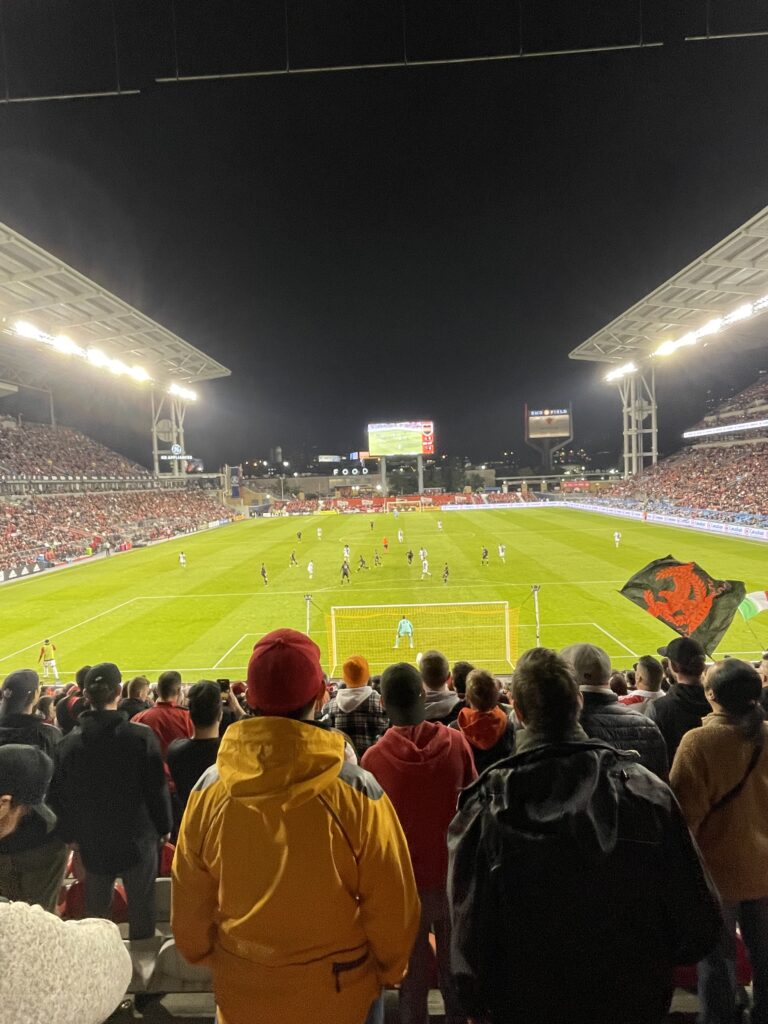
As the countdown to the 2026 FIFA World Cup enters its final 100 days, uncertainty beyond Canada’s borders is prompting fresh debate about the stability of the tri-nation tournament.
Canada will jointly host the event with the United States and Mexico, the first time FIFA has awarded hosting duties to three nations. Canada is scheduled to stage matches in Toronto and Vancouver, starting June 12, while Mexico is expected to host roughly a dozen games across its selected cities.
However, recent reporting from the Canadian Soccer Daily has questioned whether escalating cartel violence in Mexico, along with political polarization and immigration enforcement controversies in the U.S., could affect logistics, fan travel or even venue assignments.
The scenario has sparked online speculation, with Frédéric Dimanche, a professor at Ted Rogers School of Hospitality and Tourism at Toronto Metropolitan University (TMU), noting that some fans have cancelled their tickets and trips to the U.S. and Mexico.
But Dimanche and other experts caution against assuming drastic changes are imminent.
“Of course, it’s deeply concerning to see tensions around the world today, particularly in parts of Mexico and elsewhere,” said Domenico Folino, a licensed FIFA agent who is primarily responsible for leading FIFA’s strategic project.
“Everyone in football hopes stability and calm prevail well before the tournament,” he said.
On The Record reached out to FIFA’s media team, but has not yet received a response.
FIFA awarded the hosting rights in June 2018, following an extensive evaluation of infrastructure, security, and political stability across all three countries. These tournaments are planned years in advance with contingency measures built in, according to Dimanche.
“People are reacting very quickly to recent events, first to U.S. politics, and now to the situation in Mexico, which is serious,” said Dimanche.
“But it’s only been a couple of days. You’re not going to decide this magnitude overnight.”
Dimanche noted that mega-events like the World Cup are built on years of preparation, contractual agreements and infrastructure investment. And unlike smaller tournaments, he said relocation is not simply a matter of swapping stadiums.
“When a country wins a World Cup bid, preparation begins six or seven years in advance. It requires enormous infrastructure, planning and coordination. For that reason, I don’t see the tournament moving out of North America,” said Dimanche.
FIFA’s commercial agreements, ticket allocations and sponsor commitments are tied to specific venues, making last-minute structural changes disruptive and costly.
Meanwhile, Canada’s own hosting capacity also limits how much additional responsibility it could realistically absorb if more games are moved to Canada. With only two confirmed host cities and stadium capacities that are modest compared to several U.S. venues, a wholesale shift northward would strain infrastructure, security operations and scheduling.
“We’re simply not equipped for that. We don’t have enough stadiums, and you can’t just double the number of matches. What would usually take a year or so to plan would need to be done in two months, if that.” Dimanche said.
“Timeline-wise, it creates a challenge.”
While plausible, tourism and travel expert Vinnie Vats agreed that game relocation would be far from simple.
“There simply isn’t enough time to rebuild the tournament structure from scratch,” Vats said. Adding a few games in Edmonton is possible, he said, but “their stadium readiness is… in question.”
Even the playing surfaces pose practical constraints. Tournament schedules are tightly managed to allow for pitch maintenance and broadcast turnaround.
“A football field needs time to recover between games,” Dimanche said. “You can’t host matches back-to-back without allowing several days for restoration.”
If adjustments became necessary, experts suggest the United States, which is already hosting the majority of matches, would likely be the first to redistribute games internally.
“Several Major League Soccer markets already meet international standards and could, in theory, take on limited additions,” said Dimanche.
“You might add one or two matches to existing host cities,” he said. “But we are far from that decision that needs to be made immediately.”
Even if match locations remain unchanged, the broader question is how global perception may influence travel patterns.
Mega sporting events rely heavily on international visitation. The 2026 tournament is expected to feature 48 teams and 104 matches, making it the largest World Cup ever staged. “With that scale comes dependence on cross-border mobility and fan confidence,” said Dimanche.
“Perception can carry as much weight as reality,” he said. “If people perceive instability or political risk, they may decide not to travel.”
Wayne Smith, another hospitality and tourism management professor at TMU, emphasized that large-scale events operate within extensive security frameworks designed specifically to mitigate these risks.
“Hospitality and tourism is a safety and security industry,” Smith said.
“Regarding the World Cup in Mexico, it is in everyone’s best interests to ensure it is safe for guests,” he said. “Given the security at these types of events around the world, I would expect that they are doing everything possible to ensure guest safety.”
During a press conference on Tuesday, FIFA president Gianni Infantino confirmed the organization is “monitoring the situation in Mexico.”
“But I want to say from the outset that we have complete confidence in Mexico, in its president, Claudia Sheinbaum, and in the authorities, and we are convinced that everything will go as smoothly as possible,” said Infantino.
It’s also worth noting, as Smith said, that fan behaviour at the World Cup is often driven less by geography and more by team allegiance, meaning supporters typically organize travel plans around their national squad’s match schedule.
“The World Cup is team-dependent,” he said. “Generally, fans follow their team wherever it goes, so it is more a case of: ‘Do I go to watch my team live, or not at all?’”

Anish Dhupar is a fourth-year journalism student and a storyteller for On The Record, winter 2026.
In producing this story, Grammarly was used in assisting with grammar.