
AI disclosure statement: In producing this story we used Otter.ai for transcribing interviews.
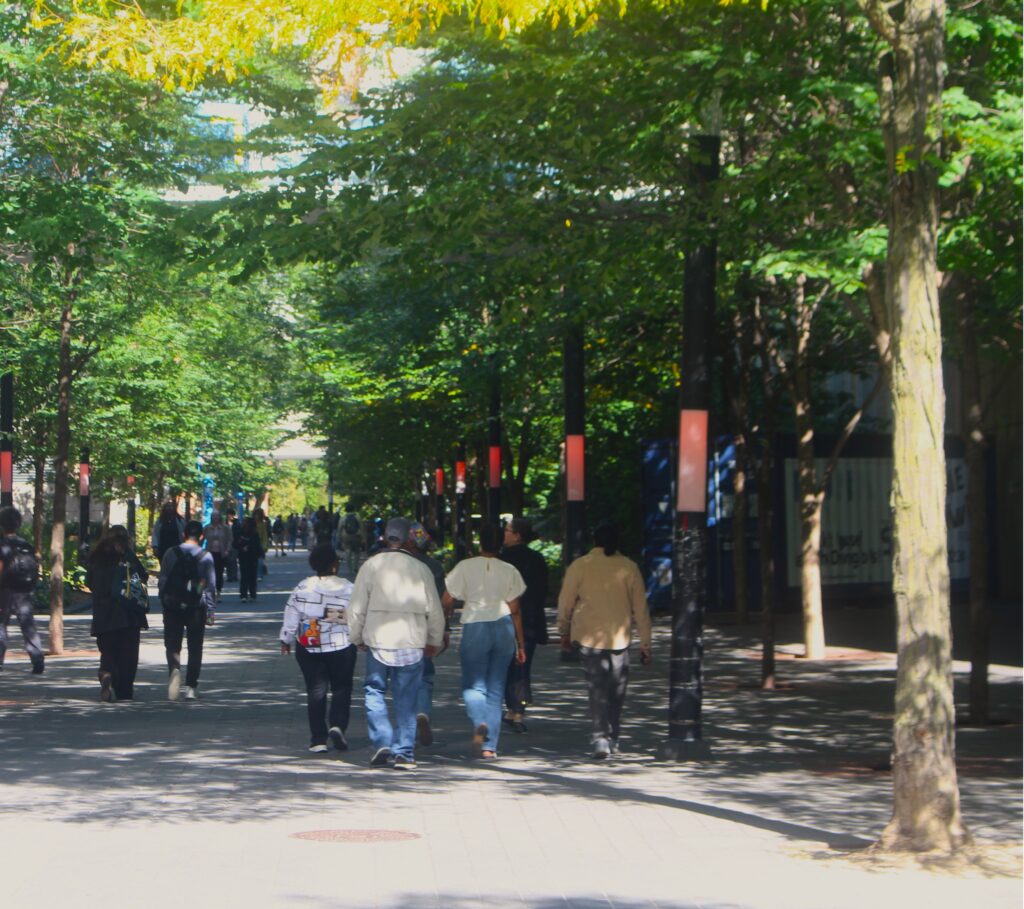
“When I was working two part-time jobs, I did not have time to talk to my friends,” said a general board member at Students for Barrier-Free Access (SBA), a student-run group at the University of Toronto (U of T), who asked not to be named for this story. “Disability justice to me means that no one is cast out.”
Nearly two-thirds of people with disabilities in Canada (64 per cent) reported feeling lonely in 2022, according to a Statistics Canada study released Oct. 14. It uses data from the 2022 Canadian Survey on Disability, and StatCan notes that loneliness “has increasingly been recognized in recent years as a growing public health challenge.” While the study doesn’t focus on students, this story looks at how loneliness plays out on campuses, particularly for students with disabilities, and what their schools and student groups are doing about it.
Michael Bach, a senior advisor at the New Society Institute and an adjunct professor in disability studies at Toronto Metropolitan University(TMU), said in an interview the findings match his research going back to the late 1980s. But he said disability itself isn’t the cause.
“It has nothing to do with the disability,” Bach said, referring to people who end up housebound without support. “It has everything to do with the lack of investment that we make as a society and the ways in which our communities are just not structured to provide that kind of support.”
What the data shows
Statistics Canada sought to measure loneliness by asking questions about lacking companionship, feeling left out and feeling isolated from others. Loneliness rose with the severity of disability, from 55 per cent among people with mild disabilities to 63 per cent (moderate), 71 per cent (severe) and 78 per cent (very severe).
Bach said severity of disability appears to be a “determining factor” in who is included in education, housing and work.
Statistica Canada data also shows loneliness tracked with other hardships. Almost one in three people with disabilities (31 per cent) lived in a household experiencing moderate or severe food insecurity. Loneliness was far more common among them (79 per cent) than among those who were food secure (57 per cent). More than one in 10 (12 per cent) were housebound, meaning they often or always couldn’t leave home because of their condition. Of that group, 88 per cent reported being lonely, compared with 61 per cent of those who weren’t housebound.
“It’s poverty and it’s the much higher likelihood of living in poverty,” Bach said. People with significant disabilities are “less likely to be able to access the labour market,” he said, and “people aren’t getting the support they need.”
“The costs of support to participate in the community, the costs of transportation become prohibitive when people are living in such dire poverty,” he said.
But Bach also said the study doesn’t do enough to examine how disability intersects with other forms of marginalization. He said the New Society Institute’s work looks at racialized, Indigenous and 2SLGBTQ+ people with disabilities, as well as immigrants and refugees. “It’s not one factor that drives this necessarily,” he said.
What TMU is doing
“Reducing social isolation and fostering a sense of belonging are key goals of our peer support programming,” wrote Brian Williams and Priyanka Sahajpal of TMU’s Peer Support & Health Promotion in an emailed statement.
The team wrote that the groups are open to students with disabilities, and that it has partnered with Academic Accommodation Support “to offer a peer support group specifically for students with disabilities, helping them navigate day-to-day challenges, connect with others who share similar experiences, and feel supported throughout their university journey.” Another group, Divergent Minds, is specifically designed for neurodivergent students, Williams and Sahajpal wrote.
The Statistics Canada researchers found that people who were housebound were especially likely to be lonely. “We recognize that some students may face mobility, health-related or other barriers to attend peer support groups in person,” Williams and Sahajpal wrote. “To address these gaps, we offer hybrid options for our peer support groups, allowing students to participate virtually if they are unable to attend in person.”
What universities can do
Bach said post-secondary education helps. People with disabilities who graduate and get support to enter the workforce tend to have higher employment, he said, and are “likely to have more extensive social networks… The data shows that postsecondary education can make a real difference.”
For universities, Bach said the fix starts at the top. “You need leadership and commitment from the top,” he said, “from the president and the senate all the way down.” That means, he said, dedicated resources and a campus place for social support and program adaptation, not only a trip to the disability services office. “It takes intention,” he said.
At U of T
“Isolation at U of T starts at Convocation Hall, where many first-year classes are held,” said the SBA general board member. “I only saw one wheelchair accessible seat in the entire space, and the rows of seats are so narrow, they are uncomfortable for an able-bodied person.”
They described adjusting to university life and academics in first year as tight and stressful, citing limited enrolment for certain programs and majors, pressure to achieve high grades, and the stress of balancing life with work, study and health. “Under all this pressure, relationships are incredibly difficult to create and maintain,” said the general board member. “I don’t quite believe that the way universities run, even with Accessibility Services, are conducive to student success and growth, academically, professionally or personally.”
The board member described SBA as a student-led non-profit and a space for collaboration, community and rest that provides accessible technology and a low-sensory room. “SBA is explicitly anti-capitalist. Disability justice requires us to be. Disability is slower. It needs room for delay and flexibility,” they said. While the board member said SBA is limited in the number of services it can provide disabled students as a small non-profit, events and initiatives “are our best efforts to support the community at large,” said the general board member in an emailed reply. “Perhaps the intention of SBA did not start with ‘easing loneliness,’ but it is a wonderful byproduct,” they added.

Reporter, OTR, F2026.