
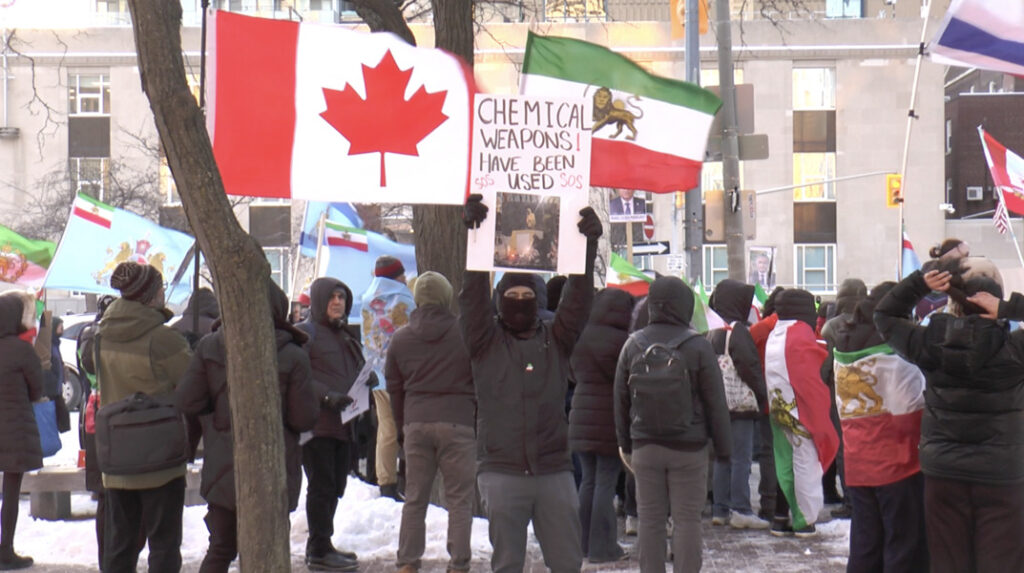
Protesters hold flags and signs during a downtown rally highlighting human rights concerns in Iran (OTR/Yoons Park)
Listen to the whole story here:
Toronto resident Yasin Zarrinkam said he hasn’t been able to communicate with his loved ones back home in Iran in two weeks. He reports lost contact with family members due to the internet blackout, surveillance concerns, and safety risks.
Zarrinkam was one of many members of the Iranian community who rallied outside the U.S. Consulate on University Avenue earlier this week, demanding accountability and international pressure — the most recent gathering amid a surge of Iran-related protests in Toronto.
“It’s really hard to be focused on everything, because I cannot even know if my family are safe at this moment,” Zarrinkam said, holding a sign calling for Iranian voices to be heard over regime propaganda.
“I’m just trying hard to be focused, and also try hard to be the voice of people in Iran.”
The demonstration comes amid ongoing human rights violations in Iran, protesting against the clerical leadership under Supreme Leader Ayatollah Ali Khamenei, who has ruled the country for nearly 40 years. Protests started in Iran on Dec. 28, 2025 due to increased inflation, leading to shopkeepers shutting down shops.
Iranian state television released the first official death toll on Jan. 21, reporting that 3,117 people have been killed in the protests that started in late December, according to Al Jazeera, PBS News and CBC.
There’s been a real change in tone in the protests as of late, said Shenaz Kermalli, a journalist who studied Iranian politics. While Toronto has seen multiple demonstrations related to Iran in recent years, she said the goals of this protest differ from what the city has seen before.
“There was just a protest for change, demanding change in Iran, which could be a change in government or a change of policy, towards women, specifically, but not towards the Shah in particular. So that’s what made this one significant and different,” Kermalli said.
With the internet blackout, Kermalli said that it is difficult to receive data and information from Iranians in Iran, and that people are afraid to speak out against the government. This makes it challenging to highlight the Iranian voices that matter most.
Zarrinkam agreed, saying fear has prevented many Iranians from speaking openly about politics or current events.
“They’re really afraid to even talk about political things. They just say that we are fine and nothing more. They cannot talk about, you know, news or political things, because we are afraid,” Zarrinkam said.
Elmira Alif also joined the protest this week, holding a sign bearing an image of Reza Pahlavi, the previous leader of Iran’s monarchy, who claimed to be the one true leader of the opposition.
As an Iranian, Alif said she is protesting to amplify the voices of people in Iran who are unable to speak freely amid internet shutdowns imposed by the Islamic Republic.
“We’re hopeful that [U.S.] President Trump would help Iranian people with military actions. Because, as you know, people are risking their lives in the streets and our Islamic Republic is actually doing massacre, killing all the people,” she said.
Kermalli meanwhile, said she doesn’t think the west should interfere in international government affairs, as she said U.S. economic sanctions have played a large part in creating the current economic catastrophe.
“If you want to support Iranians, then say no to economic sanctions and all colonial interference or foreign interference… They have been imposed on Iran for decades and decades, and they have been crippling sanctions where they don’t have access to medical supplies and healthcare equipment,” she said.
The U.S. has been taking advantage of the natural resources in Iran, and that Iranians were also aware of how much their resources were being taken by external Western powers, said Kermalli, who has studied the history of U.S. interference in Iran, specifically their government processes and diplomacy.
Kermalli said that Western leaders and governments should call out human rights violations, but should not attempt to intervene with policies.
Regardless, the restrictions on communication are making it difficult for people inside the country to share information or seek international attention, leaving supporters feeling a responsibility to speak out.
“We will fight until we win, for sure,” said Alif.


Otter.ai was used to transcribe the interviews in this story.
