AI disclosure statement: In producing this story we used Grammarly to check spelling and grammar.
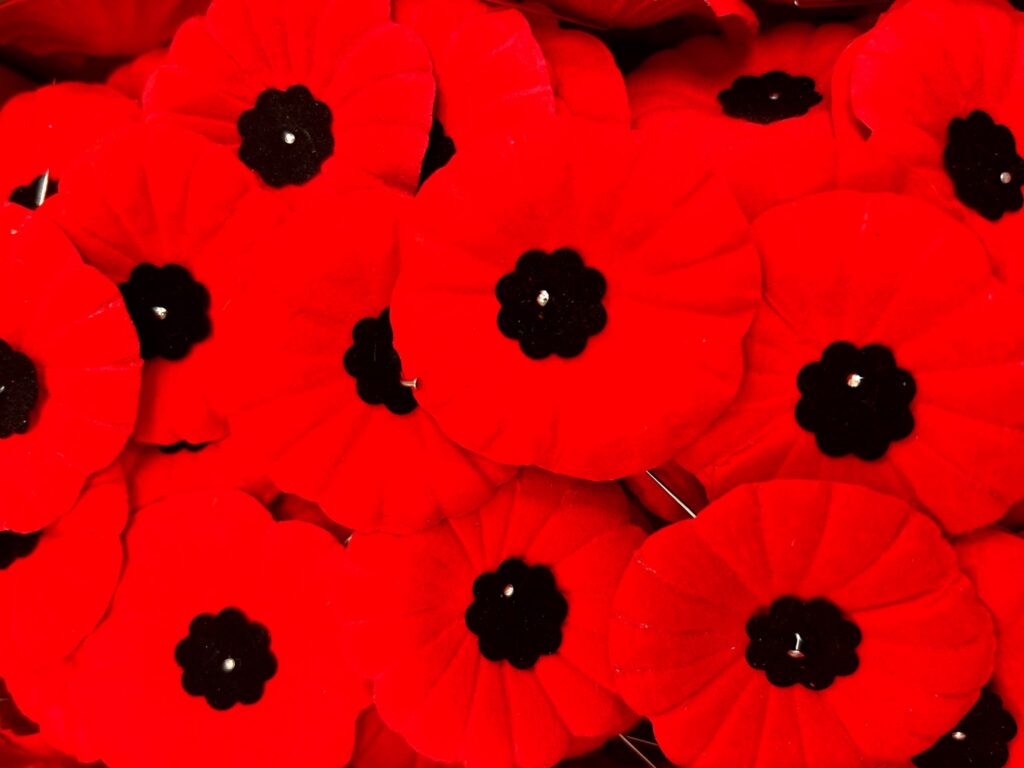
From the last Friday in October until Remembrance Day, millions of Canadians wear a red poppy, a symbol that honours Canada’s veterans and those who died in service, but for many, the history behind the symbol can be unclear.
“I can’t say that I know much about it, except that we honour and respect the veterans and we have moments of silence,” Behishta Kabir said. Kabir is a fourth-year community services and social work student at Toronto Metropolitan University (TMU). She said she learned about Remembrance Day in elementary school and points out that “I see less and less people wearing poppies now.”
Dr. Dan Horner, a historian and associate professor of Criminology at TMU, said, “There are plenty of adults and people born and raised in Canada who don’t devote much energy to thinking about the past and the way that it shapes our contemporary society.” Horner said he thinks that Canadian society can be deeply enriched by robust discussions of what Canada can contribute to the world in times of conflict.
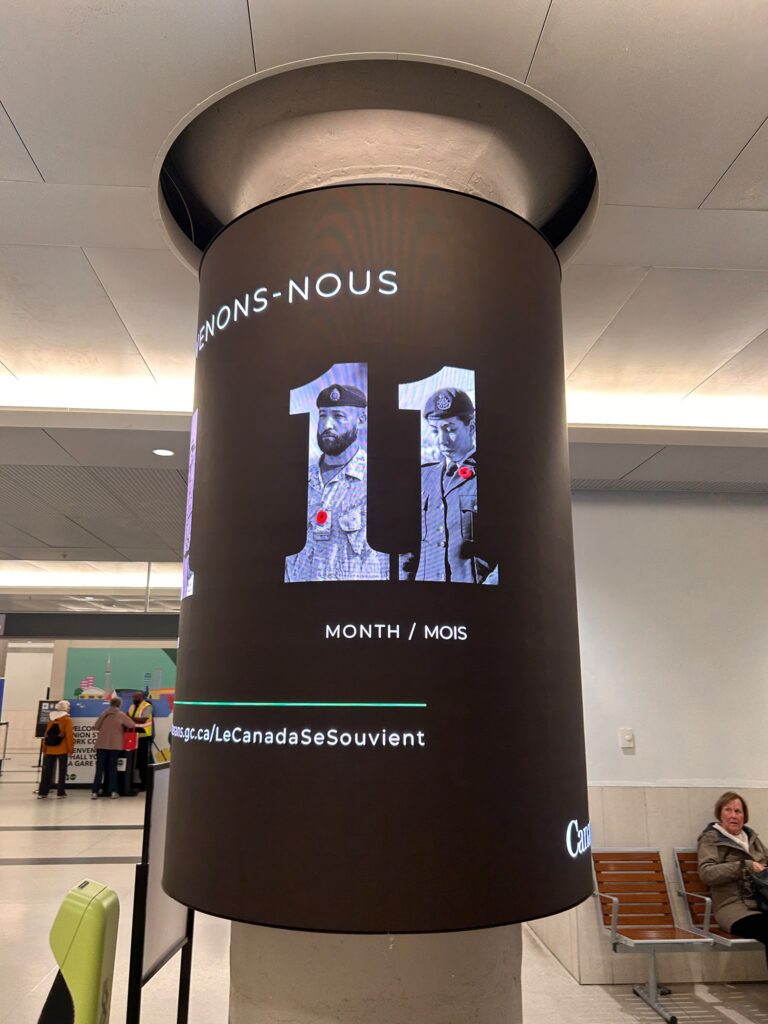
Remembrance Day is observed annually on Nov. 11, the anniversary of the 1918 armistice that ended the fighting in the First World War.
“I believe that at the veterans’ graves, there were these poppy seeds, and they mostly grew there, so they became a symbolic message of their sacrifices,” Kabir said.
“There is like something that happened in a Flanders field where there were poppies, and then that’s where the representation or the symbolism comes from,” Layla Asaf said. Asaf is also a fourth-year community services and social work student at TMU. She said she doesn’t remember much of the history, but for her, the day rings hollow. “I think that Remembrance Day is hypocritical,” she said. “It’s hypocritical for our government to be pushing that when we perpetuate so much war, and we are supporting and are in alliance with countries that still perpetuate and still fund war and genocide all over the world, including in Afghanistan, including in Palestine.”
Dr. Horner said Canadian engagement in global conflicts ought to reflect Canada’s values and do whatever is possible to protect vulnerable populations. But, “It’s not always easy to draw a clear line between what we might think of as a protective, peacekeeping operation and an aggressive military one. This is why we have seen operations in places like the former Yugoslavia, Somalia, and Afghanistan become so contentious.”
However, Dr. Horner doesn’t agree that Canada should adopt a purely isolationist approach to conflicts occurring outside its borders. “Canada has a role to play in broader efforts to bring stability to parts of the world reeling from conflicts spurred by desperate and despotic regimes,” he said.
According to the Royal Canadian Legion, poppies grew thickly over soldiers’ graves in Flanders, turning former battlefields red.
That “something” was a poem. John McCrae, a Canadian doctor, poet and soldier, wrote “In Flanders Fields” on May 3, 1915, the day after his friend Lt. Alexis Helmer was killed during the Second Battle of Ypres.
“In Flanders fields the poppies blow
Between the crosses, row on row,
That mark our place; and in the sky
The larks, still bravely singing, fly
Scarce heard amid the guns below
…”
In January 1918, McCrae became the first Canadian named consultant physician to the First British Army. He died of pneumonia and meningitis on Jan. 28, 1918.
His poem inspired Anna Guérin of France to propose the poppy as a symbol of remembrance. The Great War Veterans Association, a forerunner of the Royal Canadian Legion, adopted it on July 6, 1921, and Canada’s first “poppy day” was held on Nov. 11 that year.
The Legion has run its Poppy Campaign every year since it was founded in 1925. “Poppies are distributed freely, but your generous donations are invaluable and welcome,” the Legion writes on its website.
Canadians first marked Armistice Day on Nov. 11, 1919. From 1921, it was held on a Monday alongside Thanksgiving. In 1931, Parliament fixed the date at Nov. 11 and renamed it Remembrance Day, according to The Canadian Encyclopedia.
Veterans Affairs Canada’s military history section lists six wars and conflicts Canada has fought in since 1899, from the South African War to Afghanistan, along with international peacekeeping.
The Afghanistan mission, which Canada joined after the Sept. 11, 2001 attacks, killed 165 Canadians: 158 Canadian Armed Forces members and seven civilians.
Joining a military mission in Afghanistan is controversial for many Canadians who see it as unnecessary.
In 2010, the Angus Reid Institute, a Canadian non-profit foundation it describes on its website as committed to independent research, published figures on the military operation in Afghanistan showing that more than half of respondents (56 per cent ) opposed the operation involving Canadians, while just over a third (36 per cent) supported the mission.
Asaf points out the phrase “Lest we forget.”
“But we are not only forgetting; we are obliterating their sacrifice,” she said. “What are we doing with the freedom they gave us? We’re perpetuating more war, right?”
Dr. Horner said that Remembrance Day is not a celebration of militarism. Instead, “It is an articulation of a responsibility that all of have towards those who have been sent into conflict zones in Canada’s name.”
It’s also an opportunity to think of the civilians caught in the middle of conflicts. Dr. Horner said, “These reflections should bind us together in solidarity against racism, inequality, ethnic and religious chauvinism, and political tyranny.”

Reporter, OTR, F2026.