
AI disclosure statement: AI was used to transcribe interview audio files, and Grammarly was used for spell-check and grammar-related errors.
Listen to the whole story here:
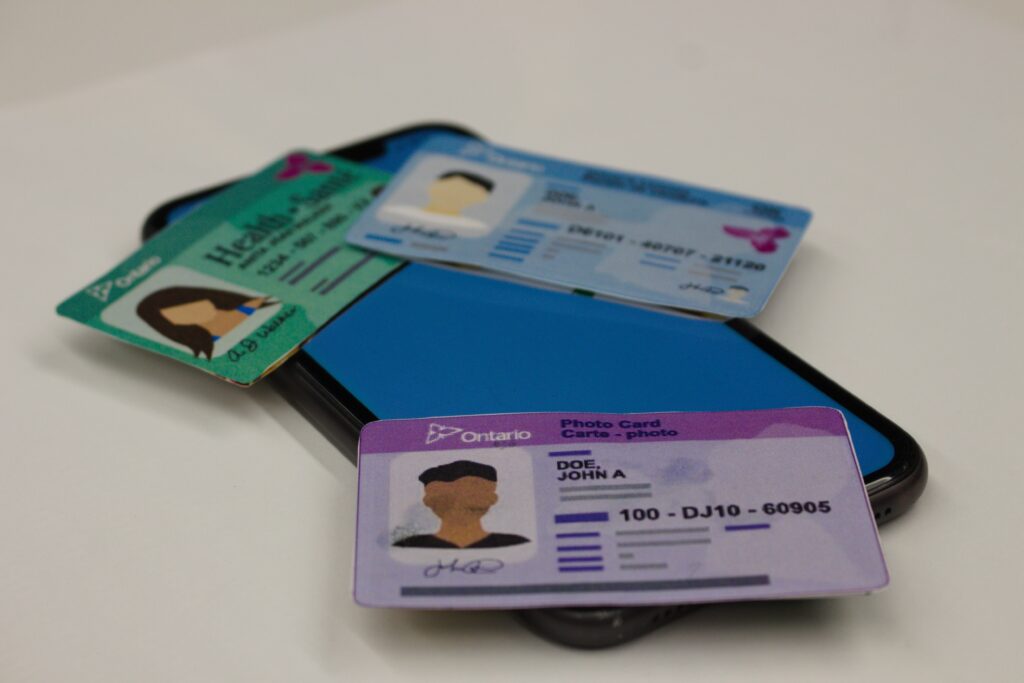
The Ontario government is introducing a new initiative that would allow for the optional digitization of provincial credentials, starting with Ontario Photo Cards. Details on how Ontarians will access their digital credentials have not yet been released, but experts say the model must prioritize privacy and transparency.
“The biggest requirement for the legislation should be interoperability: an open-source system with publicly accessible standards and technology rather than controlled by a single company,” said Jake Hirsch-Allen, director of partnerships at The Dais at Toronto Metropolitan University (TMU), who has worked in the digital ID, education credentials and verifiable credentials space for more than 15 years.
“In particular, we have to build it in a way that does not tie us to American interests, as sovereignty is going to be a huge factor in how we identify every Canadian,” he added.
In the Oct. 23 press release from the Ministry of Public and Business Service Delivery and Procurement, digital credentials “would support a more seamless and connected customer experience while providing an added layer of security by reducing the risk of lost or stolen identification and identity theft.”
Ontario is the latest province to explore digital identification.
British Columbia rolled out the first version of the BC Wallet app in 2022 to store and present digital credentials, and Alberta introduced a digital app that also stores government-issued documents, called Alberta Wallet, in August 2025. Quebec plans to implement a similar system in 2028 using Service québécois d’identité numérique (SQIN).
Although the option exists for residents in these other provinces, some still choose to carry physical IDs because they are still adjusting to the transition.
“I haven’t used it, nor have I heard,” said Elena Torelli, an Alberta resident and journalism student at TMU. “A lot of people, at least in my circles, are talking about it, just because I think it’s still in that transition phase.”
Alberta and British Columbia currently use a W3C Verifiable Credentials Data Model to support digital credentials for their residents.
This system allows the government to issue digital credentials directly to individuals, who store them and present them to verifying entities.
Hirsch-Allen said all digital ID systems have privacy risks.
“Digital IDs present some serious privacy concerns in the sense that they do often contain identifiable information about an individual that, if leaked or if connected to other information, could be damaging,” said Hirsch-Allen. “However, if they are designed to limit how much personal information is shared and keep databases separate, they could actually protect people’s privacy information better than some existing system.”
One TMU student said he is uncertain whether he will choose to convert to a digital form of ID, but concerns about preserving personal data wouldn’t be what stops him since the government already has his data.
“Whenever I go on a website, they’re always asking me to accept cookies, and I have to accept it,” said Dylan Isog, a sports media student at TMU.
Raja Baig, a third-year social work student at TMU, said that while a digital ID seems convenient, keeping it optional is key.
“It can also be convenient in some ways, but it is a bit concerning,” said Baig. “I would like to know the policies and things like that, and where it’s going to be kept.”
Meanwhile, on the other end of the ID argument, one Toronto bar owner raised concerns about what it could mean for situations where proof of age is required.
“Now it’s the program doing the work; it’s not a human doing the work,” said Julian Altrows, owner of Black Pony Cafe and Snack Bar, which serves alcohol in Toronto’s east end.
Altrows said he’s worried that replacing physical IDs with digital IDs puts verification in the hands of a third party to ensure patrons are of legal drinking age, which could skip human judgement.
Hirsch-Allen said losing the human element in ID verification is an overarching issue, especially for the younger generation.
“We are trending towards less human-to-human interaction and more digital-to-digital interaction for more efficiency and less resistance,” said Hirsch-Allen. “Many of the problems associated with the younger generation are linked to a lack of social interaction, spending too much time online, and not interacting with other people enough.”
If done properly, digital IDs could present the opportunity to decrease the privacy concerns in government-individual interactions.
“You wouldn’t necessarily have to give the bodega your date of birth, your name, your address, any of that,” said Hirsch-Allen. “You would simply be verifying your age.”
However, Hirsch-Allen warns that the system put in place must protect Canadian sovereignty.
“My fear is much more that you’ll have Apple or Google come in and then the problem is you’re actually giving those companies access to that information.”
While opting into this phase of digital ID is optional, it may not stay that way.
“We need to think about [the implications] of a mandatory integrated digital ID when they’re creating this optional single-purpose digital ID because that’s going to be the model; it’s just going to creep,” said Jacquie Burkell, a professor in the Faculty of Information and Media Studies at Western University and scholar-in-residence at the Office of the Information and Privacy Commissioner of Ontario (IPC).
Burkell warns that youth are the most vulnerable age group in the long term when it comes to privacy legislation and that it’s necessary to ask questions about who can access people’s data and what information is being collected.
“The real risk is 10 years from now when everybody has a digital ID card, and we never asked the questions at the beginning,” said Burkell.

Reporter, OTR, F2026.

Meriem is a third-year journalism student and a reporter On The Record, Fall 2026.
