
AI disclosure statement: In producing this story we used Otter.ai for transcribing and recording of interviews.
Listen to the whole story here:
Heading into the 2026 municipal election, candidates from Oakville to Toronto to Mississauga are finding that their support or opposition to new builds of data centres are important to their voting constituents.
“We felt the need to come together to remind our Town Council that they represent the residents of Oakville and that we will vote to replace them in the next election if they lose sight of it,” said Nikki Mutch, answering on behalf of the No Data Centre Oakville group in an emailed reply.
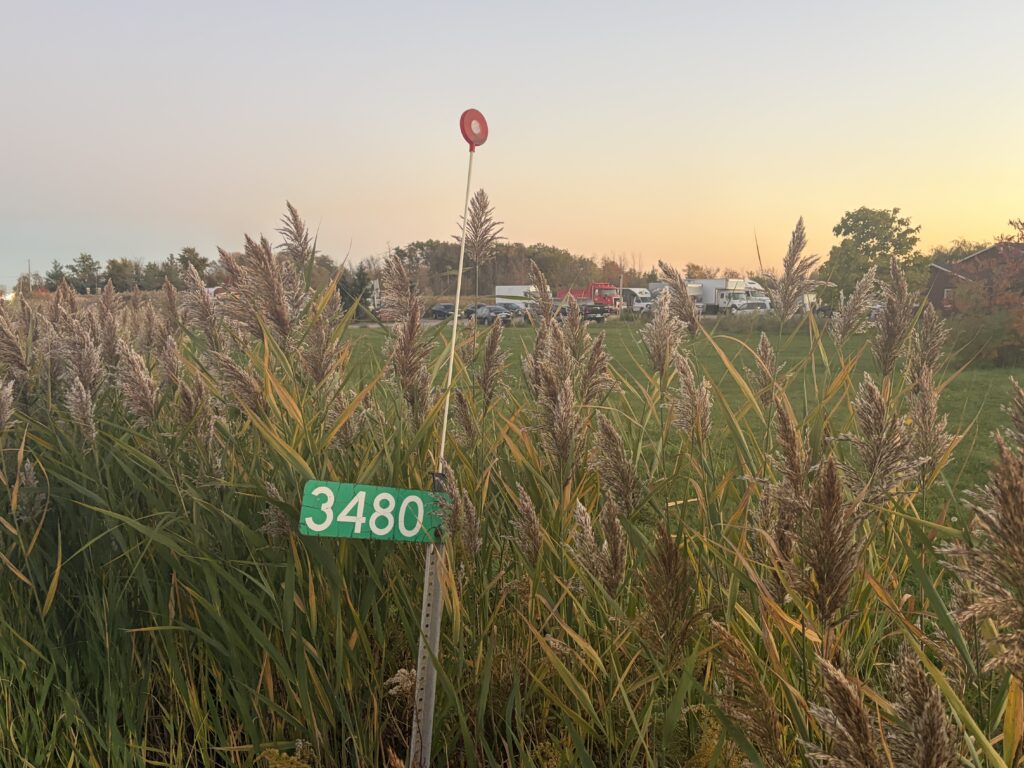
In Oakville, HIVE Digital’s subsidiary Buzz HPC purchased 25 acres of land for $58 million at 3480 Ninth Line, and has publicly committed to a $3.5 billion, 320-megawatt (MW) AI data centre that would make it one of the largest in Canada, if built. The town has yet to receive a formal application, but was aware of the proposal when it implemented a one-year moratorium on all AI data centre developments via an Interim Control By-Law (ICBL) in August 2026.
Ward 6 candidate Smita Tulsani called the pause a “responsible first step,” in an emailed reply to questions, but said the real test is what standards the town produces during the year — on separation, noise, and infrastructure capacity — ideally before, not after, proposals like this are floated.
Meanwhile, Ward 2 candidate Julia Hanna posted an Instagram reel on Sept. 29 advocating for a planning review of the proposed data centre.
What happens when the moratorium lifts is still an open question; one that’s being asked all across the GTA, as more data centres projects seek permission to be developed in Ontario. Oakville’s standoff over 25 acres is a local example of a broader phenomenon: as AI infrastructure investments accelerate across the province, who decides where it goes, how fast, and at what cost to the grid?
What’s Being Proposed?
HIVE/BUZZ HPC says in their press releases the facility would house more than 100,000 graphics processing units (GPUs), generate over 800 construction jobs, and create hundreds of permanent skilled positions. The company announced the project in May 2026, saying only that it would be somewhere between Toronto and Waterloo. Residents connected it to the Ninth Line site weeks later, after the property turned up in a real estate listing. No formal application has been filed with the Town of Oakville, but a staff memo delivered on Aug. 4 acknowledged pre-consultation discussions that “indicate a market interest” in the municipality.
Oakville’s Ward 6 Councillor, Tom Adams, whose motion triggered the moratorium, framed the town’s position carefully during an interview: data centres themselves aren’t inherently the issue: “There are data centres already all over Canada… I don’t think that it’s a question of saying absolutely no, never.” What matters, he said, is “making sure that the public good in the planning process is maintained.”
How Residents Organized
The moratorium didn’t emerge from council alone. Nick Tsergas, an organizer with Stop The Data Centre, said in an interview that resident opposition in Oakville traces back to a late-July Reddit post on r/Oakville describing rumours of a hyperscale AI data centre planned for the edge of town. Credible, he said, because the developer’s own materials had promoted the plans. Within roughly a week, a small group of Tsergas and four or five residents had grown into a 150-person WhatsApp group, lobbying councillors and Ward 6 candidates. One such concerned resident, Mutch (also affiliated with the Stop the Data Centre group), shared her response via an email:
“I think the general sense was that if HIVE / BUZZ HPC had already purchased the land and advertised on their website that they were building a 320-megawatt data centre in the GTA, there was a strong likelihood that the municipal and provincial governments were already in alignment with the plan… We had recently watched Hamilton’s city council flip their votes after meeting with AI data centre lobbyists… When you see your elected officials putting the interests of foreign corporations ahead of the people who pay their salaries, it undermines the very foundation of representative government.”
Tsergas argued during an interview the core regulatory problem is that AI data centres are being evaluated under the same municipal planning frameworks as older, far less power-and-heat-intensive data centres, despite GPU-based hardware that draws exponentially more electricity and produces significantly more heat. That distinction, he said, is why groups like his are pushing municipalities to treat AI data centres as a genuinely new land-use category, with enforceable conditions, rather than approving projects based on developers’ representations about scale or cooling tech that could change after approval.
A Provincial Surge, Not Just a Local One
Oakville’s freeze is one of several scenarios breaking out across the GTA. Mississauga followed with its own ICBL; Burlington opted for a broader framework instead of a moratorium; Toronto chose project-specific review; Hamilton, council considered but ultimately rejected an ICBL for a proposed data centre on former Stelco lands, following an information workshop in July.
Alvin Tedjo, currently a Mississauga councillor, but running for mayor in the October election, created an entire social media campaign around “No. New. Data Centres.” The current mayor of Mississauga (Carolyn Parrish) is also campaigning for re-election and signed a “Stop the Datacentre” pledge according to Global News.
Across municipalities, Oakville’s own comparative staff analysis, found a common list of unresolved questions: electrical servicing capacity, water and wastewater demand, noise, environmental impact, and zoning compatibility. Coun. Adams said he sees the pattern too: this is “a matter of great public debate… not only across Oakville but across the GTA and Ontario, and for that matter, federally across Canada.” Behind it sits a number no municipality controls on its own: how much electricity Ontario’s power grid can actually absorb, and who pays for the capacity.
The Province Responds
That cost question has an early answer. In a statement to OTR, Effie Triantafilopoulos, MPP for Oakville North-Burlington, confirmed that under Bill 40, “no digital infrastructure project will proceed unless the company commits to paying the full cost of the energy it requires.” She declined to weigh in on Ninth Line specifically, calling the moratorium an appropriate use of that time, and said residents “deserve full transparency and meaningful opportunities” to weigh in. She pushed back on framing this as a binary choice: “Ontario is home to approximately 26,000 technology firms employing 450,000 people across the province. As demand for artificial intelligence infrastructure grows, Ontario has an opportunity to attract investment, create high-value jobs and strengthen Canada’s data sovereignty by supporting secure infrastructure that keeps Canadian data in Canada.”
Anne Pasek, a Trent University professor who studies data centre contestation, questions the framing of projects like this as “green infrastructure” simply because they draw from Ontario’s grid.
“We’re pulling some nuclear assets offline for refurbishment. And so as we contemplate adding new load to the system, that load is going to get serviced by gas.”
Pasek also had thoughts about developers’ promises at this early point in the process, such as closed-loop cooling. “Unless you get it in a legally binding document, such as when you go through planning approvals or when you’re signing a community benefit agreement, it is just a nice idea. It is not actually a commitment.”
“It is kind of like a nuclear button that a city can push at some cost to itself,” Pasek said of ICBL’s like Oakville’s. “It can only push this button once, and then there’s a three-year cooldown. So it’s not a small thing. But the stakes are such that many cities are moving in that direction.”

Reporter, OTR, F2026.