
AI disclosure statement: In producing this story we used Google Gemini to help organize our points and ideas for an outline.
Listen to the whole story here:
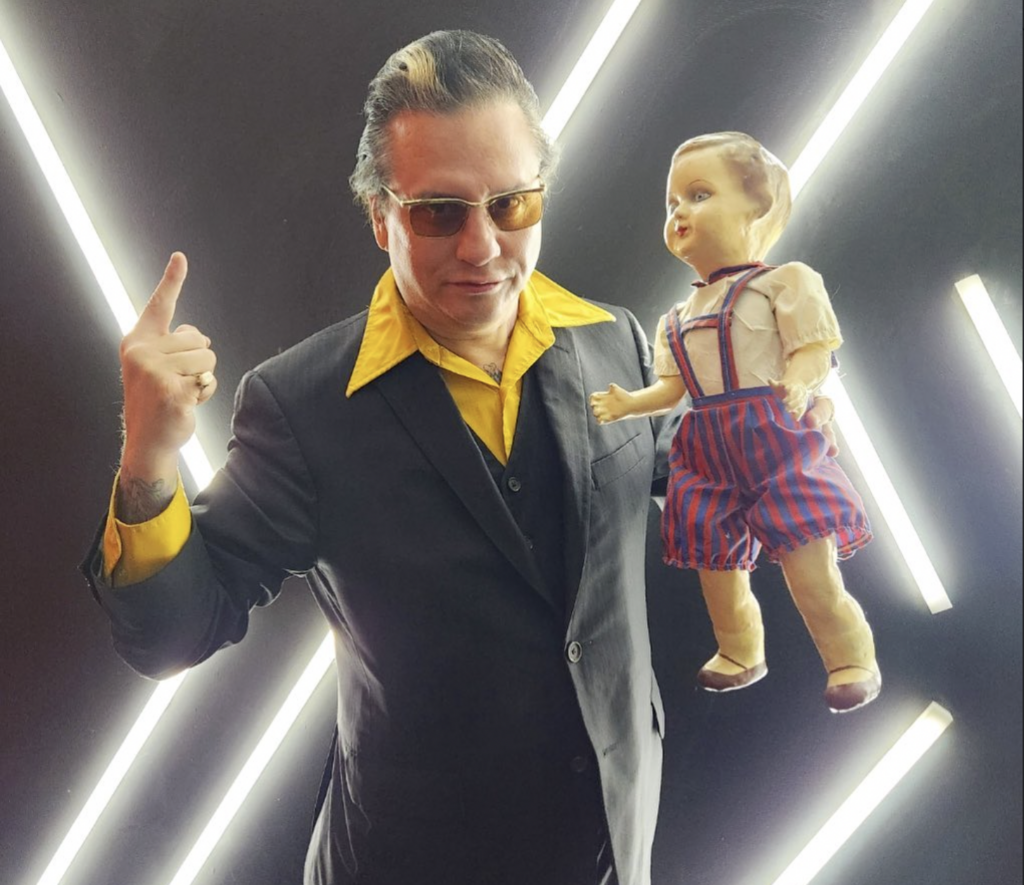
If you spend enough time wandering around Kensington Market, you will eventually run into its pillars — the people who have proudly occupied the corner of Toronto since the late seventies and plan on dying a painful death before the neighbourhood is no longer home to them. One of these pillars is Christopher Doyle, a self-proclaimed “walking oddity” who has been a longtime figure of fun and shock in the already quirky market.
The community has an earnest, messy grit that you instinctively want to bottle, and it is in this specific atmosphere that you find Christopher Doyle. Known professionally as Mysterion, he is a mentalist who looks less like a magician and more like the neighbourhood’s shadow with his entirely black get-up, his makeup and his tattoos, his look juxtaposed by his inviting energy that makes you not be able to look away.
Inside a dimly lit room in the city’s west end, he is conducting a seance for a small group of paying attendees, a show he put on with his business partners. There are no crystal balls or theatrical smoke, just a man with tattooed forearms and silver rings sitting at a velvet table. He doesn’t claim to have supernatural powers but rather operates on a level of hyper-observation that feels just as unsettling, cataloging the micro-tremors in their hands and the “autobiography” Doyle says is written in their posture.
Doyle’s ability to read a room was not born in a theatre, but in the social housing complex of Lawrence Heights, known locally as “The Jungle.” Growing up in that environment, he says observation wasn’t an entertaining trick, it was a survival mechanism. He learned early on that being able to predict a stranger’s intent by the shift in their weight was the difference between safety and trouble.
“David Blaine took his magic into the jungle,” Doyle notes, “I used to take my magic into neighbourhoods that people wouldn’t even drive through.”
He treats the performance and the stage with an almost utilitarian attitude says his mentalist partner, Steffi Kay. Growing up in Toronto’s notorious Lawrence Heights, Kay sings his praises for being a “sunny storm cloud with his dark hair and makeup, he can be a scary looking guy, but he really is such a pillar,” said Kay. Being raised alongside “scary people,” he learned that the secret to connection is treating everyone with the same level of presence, something that Kay says has not wavered since the pair first met over a decade ago.
His compassion for others comes out more literally, with one of the more persistent threads throughout the seance being the repeated reference to the Siamese twin, a narrative he uses to explore the idea of a split identity. Whether or not the story is literal or performance art, the 8-inch scar running down his abdomen serves as a perfect metaphor for his career: he is a man split in two, constantly living in two states at once.
He is a skeptic who spent his youth devouring horror movies and supernatural specials, and he claims to have lived in a genuine haunted house in the 1980s. He connected with the spirit of a woman inside that house, a now pivotal moment in Doyle’s life, but rather than turning to mysticism, he turned to science. He researched the hallucinogenic poisons in Victorian wallpaper, specifically the arsenic used in popular green wallpaper dyes, and carbon monoxide leaks. He decided then that if he couldn’t explain the ghost, he would instead “be the poison that can alter your perception of reality.”
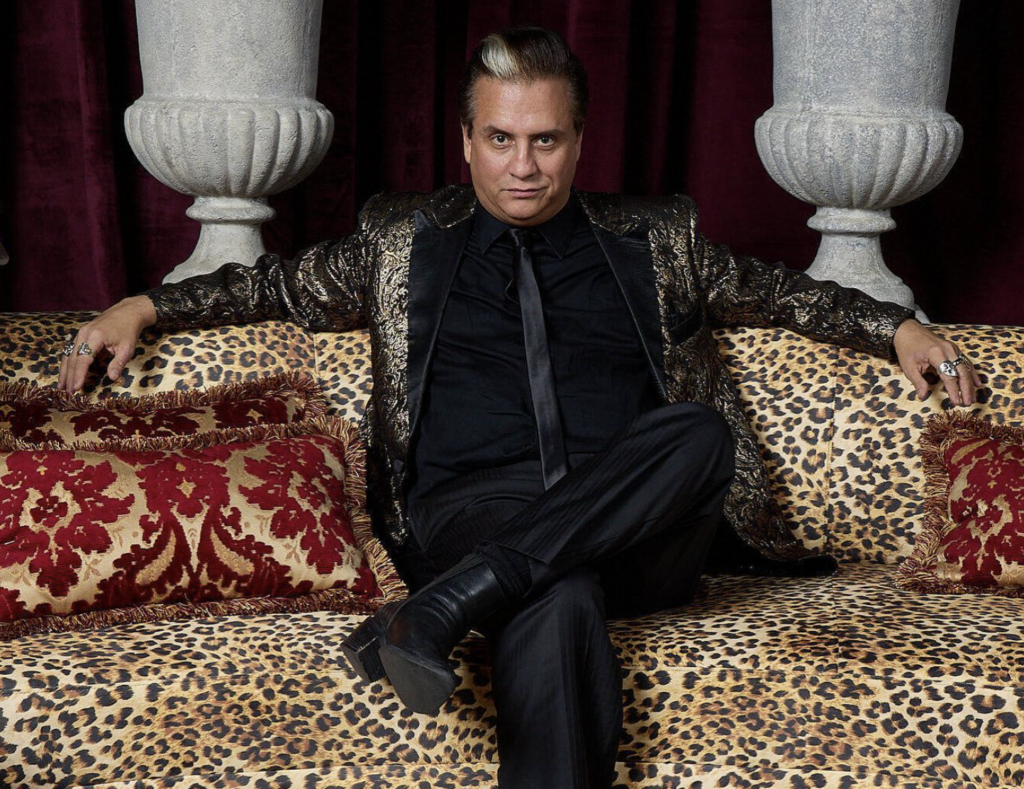
The result is a career that reads like a fever dream of subcultures. Doyle has managed professional wrestlers, opened for Ryan Gosling’s band, Dead Man’s Bones, and performed for the punk legends, The Exploited. As half of the duo The Sentimentalists, he fooled Penn and Teller on international television, an achievement he views as a “flip of the bird” to the people who told him he wasn’t ready for the big stages. Yet, for all the high-gloss TV appearances and his time on America’s Got Talent, he remains a man oozing with compassion. He is a man who can connect with anyone using the same “random acts of magic”, whether it be captivating a room of rowdy punks for a seance or playing mentalist games with the young woman behind him — me — in line at Jimmy’s Coffee.
Perhaps the most striking contrast to his “bad guy” wrestling-manager persona is his home, which houses ten thousand vintage action figures. To Doyle, the collection is a psychological reset button that brings him the same sense of joy and whimsy that his mental games provide for his seance audience. He urges everyone to “buy their favourite toy back on eBay” as a way to return to a headspace where the imagination had no boundaries.
“Creativity only comes from that headspace,” he says. “It’s never in a box.” It is a poignant image: a man who spends his nights dissecting the secrets of adults, but spends his days surrounded by the plastic remnants of a world where everything was still possible.
Today, Doyle is in what he calls a “transformative stage.” After a decade as a high-profile duo act, he is solo again and leaning into the digital age. His recent evolution into “The Secret” on Canada’s Got Talent is a disembodied AI voice that performs on an empty stage, suggesting he is moving toward a version of mentalism that doesn’t even require his physical presence. As he disappears back into the Market, he remains an intentional anomaly. Mysterion is a reminder that the most interesting things in life usually happen in the shadows, observed by someone who was paying attention when no one else was.
As the seance ends and he prepares to head back into the Toronto evening, the conversation turns to what’s next: a cover story for a major magic magazine, a trade show in New York, and a new series of “hush-hush” projects.

