AI disclosure statement: AI was used to transcribe the interviews.
Listen to the whole story here:
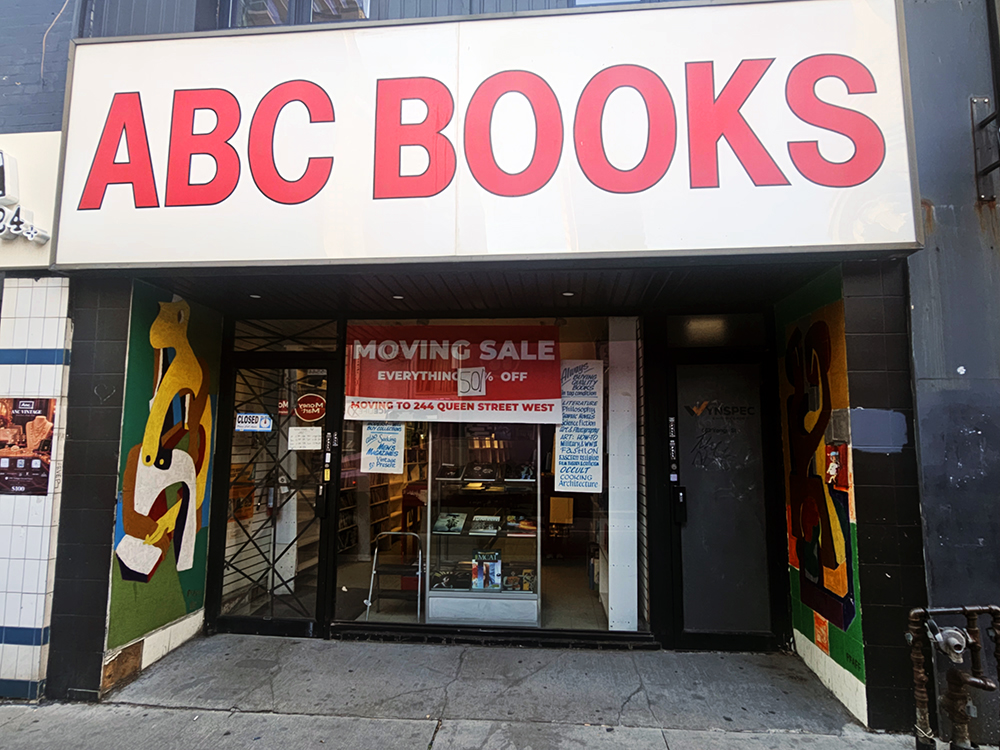
Earlier this month, second-hand bookstore ABC Books announced they’d be closing their doors on Oct.30, after nearly sixty years of selling second-hand books. Whether the store will close forever or relocate is unconfirmed, but owner Patrick Hempelmann told Toronto Life that the high property taxes on Yonge St. prompted the closing.
Last year, Better Way Alliance — a local business advocacy network — reported that commercial rent in Toronto increased by 142 per cent since 2019. The Fraser Institute similarly reported hikes in commercial rent pushing the number of industrial and office vacancies up as well.
The closure or relocation of independent bookstores in Toronto is becoming more common. For instance, Glad Day Bookshop, a bookstore that specializes in LGBTQ literature, relocated in the summer of 2025 after rent costs on Church St. became too high to manage. Similarly, Eliot’s Bookshop closed permanently in 2018 because of increasing operating costs on Yonge St., according to CBC.
“It’s almost like they’re being penalized for not being [in] high-rise buildings,” said Doug Miller, owner of second-hand bookstore Doug Miller Books on Bloor St. W.
Miller, who says he spends roughly $10,000 on monthly operating costs, is far too familiar with the hassle of relocating, given that he’s had to do it twice.
“I’ve been really lucky… you hear horror stories about retailers whose landlord just [suddenly] doubles rent,” said Peter Sellers, owner of second-hand bookstore Sellers & Newel on College St. Sellers estimates that his rent has doubled in the span of a decade, which he recognizes isn’t something all bookstore owners can say.
Although significant, the challenges of owning a bookstore aren’t limited to property bills. Another major issue is the constant competition with big box and online stores, which at times results in disappointing sales.
This was the case for the 244 Queen St. W. location of BMV Books — ABC Book’s parent company — which has closed and reopened a total of four times due to lacklustre sales according to BlogTO.
“I’ve been a lifetime book purchaser and reader… and I try really hard to learn a lot of [genres],” said Katya Nosko, owner of Great Escape Bookstore, a second-hand bookshop on Kingston Rd. Retailers can’t afford to simply stock up on whatever they find; doing so could generate abundant amounts of unrecoverable loss. Weary of this, sellers of used books develop an ability to dissect which kind of inventory would sell at their store.
Nosko was an employee of the store for over a decade before buying it in 2011. In that time, she learned from the previous owners how to successfully buy and sell books. Now, because booksellers depend on chance to find inventory, they are also subject to losing potential profit due to an inability to cater to what is in high demand.
“[Due to the Netflix adaptation] the big book right now is East of Eden by John Steinbeck,“ said Miller. “We’ve had over 500 to 1,000 requests for it, of which I’ve been able to sell zero because I haven’t had a copy come in,“ he said.
“Technically, I could’ve paid some bills with that kind of money, but unfortunately you can’t sell what you don’t have,” he said.
Miller names weather as another unpredictable element that can disrupt regular business. “It’s a big deterrent for people,” he said. “If it’s too hot, if it’s too cold, if there is too much snow, or too much rain, a lot of your walk-by is taken away. You need walk-by [traffic] to be noticed.”
Such obstacles lead bookstore owners to attempt to compensate wherever they can, which for some is covered by hosting events. Sellers & Newel takes part in this by hosting live concerts, over 600 since its opening in 2011. Similarly, Great Escape Bookstore promotes the store by hosting a yearly book and film club meeting.
Nosko said she believes Toronto neighbourhoods lose out when stores like ABC Books go extinct. “There’s nothing that goes back to your community and the employment of people around you. There’s nothing that adds to the life around you. So every time bricks and mortar goes away… it’s a big loss,” she said.
When envisioning the future landscape of independent bookstores in Toronto, community is the reason things don’t seem completely bleak to these owners.
“There are [still] people who want the experience of going somewhere to look for something that strikes them and talk to a real person about it,” said Sellers, “if enough people want what we have to offer, we’ll be fine.”

Reporter, OTR, F2026.