Listen to the whole story here:
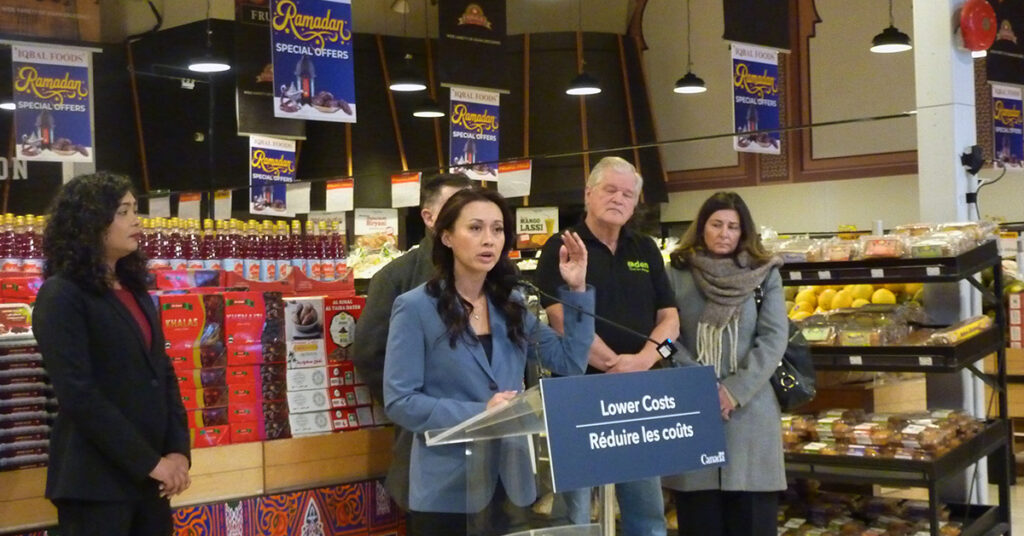
Friday morning, Federal Minister of Women and Gender Equality and Secretary of State Rechie Valdez expanded on the newly announced Canada Groceries and Essentials Benefit at a local Mississauga grocery store.
Valdez was at Iqbal Foods to answer questions and provide details to the announcement Prime Minister Mark Carney made earlier this week. Carney said that this new benefit, if passed by parliament, will support 12 million Canadians.
“This new benefit will replace the existing GST credit that you get four times a year,” said Valdez, announcing a 50 per cent increase for the first payment, and a 25 per cent increase for each following payment for the next five years. “So if you’re a single person, that means you’ll receive up to $950 this year, and for a family of four, that means they will receive $1,890 this year alone.”
Previously, Canadians could receive up to $533 per single individual, $698 for married couples and $184 for each child under 19 years of age for GST credit, according to the Government of Canada.
MP for Erin Mills, Iqra Khalid, introduced Valdez and thanked the owner of Iqbal Foods for hosting.
“This is a terrific business that so many families in my riding of Mississauga Erin Mills rely on. It’s a fitting place to have a conversation today, about affordability, about the cost of living and what it means to run a household,” said Khalid.

Valdez said Canadians can expect the first payment of the new benefit to arrive this July.
“More importantly, this benefit is indexed to inflation, and it’s paid for four times a year. That means as the cost of living changes, the benefits will adjust automatically as well,” said Valdez.
As per Dalhousie University’s 2026 Canada’s Food Price Report, the average Canadian family of four spent $16,577.16 on food in 2025. This means that the new benefit would have covered 11.4 per cent of a family’s food budget last year. However, this added benefit does not address the rising costs of groceries every year, with a four per cent increase overall on food items from 2024 to 2025.
“I think it should benefit all our customers, every dollar more or less counts toward your next grocery bill,” said Anthony Cabrel, manager at Food Basics. “But with the cost of groceries, you can’t really put two and two together, just because everything is still very expensive.”
Molad Yusuf, a mother in Mississauga, said she has to give up some items while grocery shopping.
“I have to shorten my grocery list just to accommodate what my budget is for the month,” said Yusuf.
Cabrel said the affordability issue and the added benefit are a double-edged sword.
“You have costs going up, and then you have little kickbacks. But with the overall rise in groceries, it’s very hard for families to even cope with all the price increases and everything,” said Cabrel.
Valdez responded to questions about how this benefit is part of a larger plan to increase affordability for Canadians and announced additional policies to further support affordability.
“We’re investing $20 million to support local food banks and community organisations, because no one should have to choose between paying bills and putting food on the table,” said Valdez. “We also made our National School Food Program permanent. This is going to help feed kids in school, 400,000 to be exact, across the country.”
A 2024 Statistics Canada food insecurity report found that 25.5 per cent of Canadians across ten provinces, approximately ten million people, lived in food-insecure households – an 11.4 per cent increase from 2023.
“Prices have increased very much. I came to Canada in 2018, and I could shop with $50, but now I can only buy four items for $50,” said Yusuf, on rising grocery prices.
Khalid said she hears the struggles of those within her riding in Mississauga, especially as the University of Toronto Mississauga campus is located here. She said that the government is working to ensure that students, young people and families have food on the table, noting, “the massive increase in food bank users in our riding and across our city.”
“Just make it better for people to feed, because it’s hard for people to actually feed their families if the grocery prices keep going up,” said Yusuf, on the new benefit, “so whatever they can do to help would be good.”
Valdez also told OTR about eliminating interest on federal student loans to relieve some of the burden students feel financially in addition to this new benefit. She said she understands the struggles students face, and hopes that these new policies will aid many Canadian students.

Otter.ai was used to transcribe the interviews in this story.