
AI disclosure statement: Otter.ai was used to transcribe the interview.
Listen to the whole story:
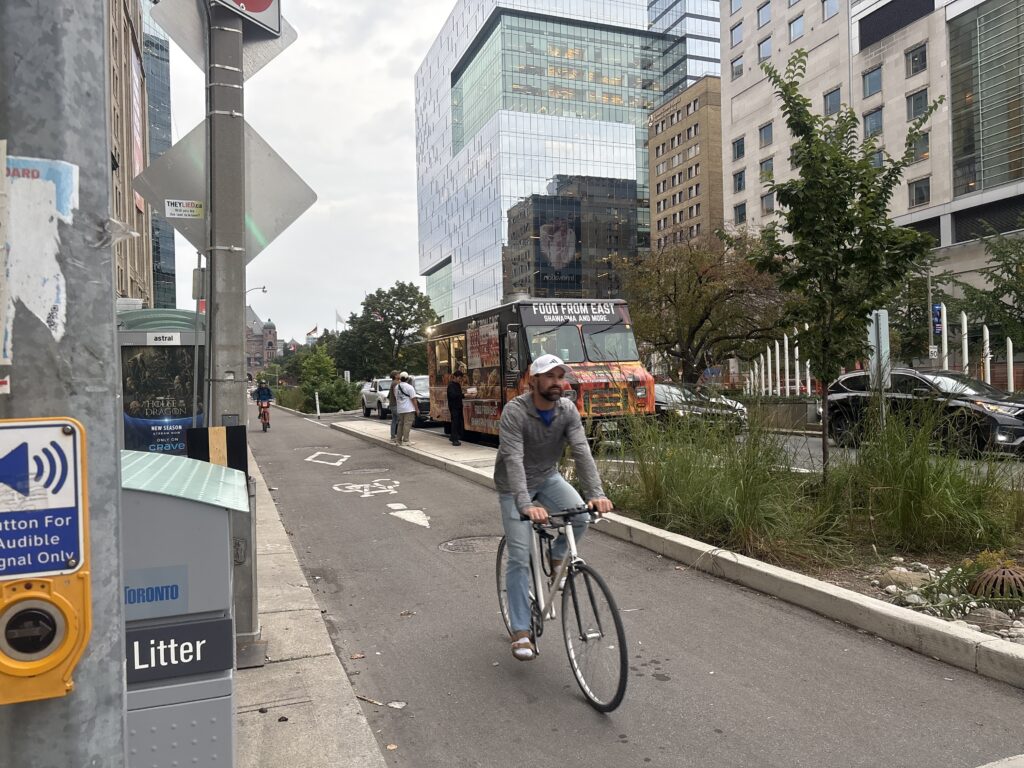
As the Ontario government moves forward with plans to remove bike lanes on some of Toronto’s major streets, the public is questioning whether the province or municipalities should make decisions about bike lanes.
A survey by Abacus Data, commissioned by Share the Road Cycling Coalition (The Coalition) and the Ontario Traffic Council (OTC), revealed that 64 per cent of Ontarians believe municipalities should decide the location of bike lanes. Over 60 per cent of Torontonians believe the same. Abacus surveyed 2,000 adults living in Ontario over August and September about this topic.
This follows the provincial government issuing a request for proposals to restore motor vehicle lanes—lanes built for cars, trucks, etc— on Bloor Street, Yonge Street, University Avenue, Queen’s Park, Queen’s Park Crescent and Avenue Road in Toronto.
Joni Sullivan, a cargo biker in the city who sold her car to afford therapy for her autistic daughter, said she fears for their safety if bike lanes are removed.
“I feel confident enough in myself at this point with my cycling abilities to ride on a road without a bike lane,” she said, “but I don’t feel confident in other drivers. I regularly have really scary encounters.”
Sullivan said she does not understand why the province has a say in decisions about Toronto’s bike lanes.
“When it comes to things like how we use space in a built environment where we live, that for me needs to be a municipal decision because it affects every aspect of the…people who live in the city,” she said.
Gian Pileri, a candidate for city councillor in Ward 11 (University-Rosedale) agrees.
“There needs to be feedback from the residents, from people who are actually using the bike lanes. There may be other people that are casual users who are not part of the [vocal] groups that I would [want to hear from],” he said.
Pileri, who lives in that ward, bikes and walks to get around the city.
“I absolutely support keeping the bike lanes,” he said. ”I’m all for being able to use the road, use the sidewalk, or any kind of public space in a safe way, and protected bike lanes…are important for that,” he said.
However, Pileri acknowledges concerns about how some bike lanes are designed.
“Sometimes the bike lanes are at sidewalk level, and there are no other markings, and they’re very dangerous. For example, a person who is blind could just walk into it,” he said. ”I’ve done that myself.”
Anthony Internicola, a candidate for city councillor in Ward 3 (Etobicoke-Lakeshore), said he has seen the negative impact of Bloor Street West’s bike lanes on local businesses despite being a biker himself.
“Business people are losing their money because they can’t unload packages, [and] they can’t [get] their customers to park in front of [them],” he said. ” If [we] wanted to put bike lanes up, let’s put [in] an infrastructure for parking so we don’t kill the businesses.”
Over 40 businesses on Bloor Street West in Etobicoke filed a $10-million lawsuit against the City of Toronto in 2025. The businesses allege the city installed the bike lanes without proper consultation, impacting them.
According to the City of Toronto, customer spending increased after bike lanes were installed on Bloor Street West, but business owners have mixed opinions.
Internicola, however, agrees that municipalities should have a say in decisions about bike lanes.
“We can [come up with] smarter ideas and listen to the residents…because it’s their voice, their streets, they pay taxes [and] they own the businesses and residential houses.”
Linda Schill, who lives in South Etobicoke, heard that bike lanes have slowed down ambulances and drivers from getting to hospitals.
“You cannot have bike lanes constraining ambulances from moving, or especially emergency vehicles,” she said, ”you cannot get sick people to the hospital on a bicycle either. That’s one of my bigger concerns.”
But Schill emphasized the importance of verifying if this is true using credible data.
According to the City of Toronto, data from Toronto Paramedic Services showed a 42-second increase around a 500-metre buffer on Bloor Street West after the installation of bike lanes. However, the citywide average also increased by 45 seconds in that timeframe.
Schill thinks municipalities and the province should collaborate on decisions involving bike lanes.
“I think all voices must be heard, and it should perhaps eventually be a municipal decision, but not when it comes to critical infrastructure for the province or the city,” she said. I’m not saying it’s only provincial [but] there should be room at the table for different opinions, without everybody throttling each other.”
Alex Bonenfant, who drives and bikes in Toronto, raised concerns about differences in each municipality’s bike lanes, when it comes to letting the provincial government make decisions.
“Every city is completely different, and the [fact that the] provincial government [is] responsible for all these completely unique different cities, that’s why a blanket bike lane policy is just not the right approach,” he said.
Bonenfant, who lives in Oakville, does not typically bike alongside cars in his city due to its trail system.
According to the Town of Oakville’s website, the city has over 260 kilometres of on-road bike lanes and off-road cycling paths.
Internicola said he wants to explore expanding Toronto’s trail system for bikers.
“If we have to innovate something, create something, let’s do it together,” he said.
Ontario’s Ministry of Transportation did not reply in time for publication to OTR News’ questions about its stance on municipalities potentially making decisions about bike lanes in the future.

Reporter, OTR, F2026.
