
AI disclosure statement: No AI tools were used in the production of this piece.
Listen to the whole story here:
Olivia Chow’s fare capping policy, which launched Sept. 1, states that TTC riders will get rides after 47 trips ride free, but student fares purchased using a post-secondary monthly pass are excluded from this new policy. While the TTC advises students to take advantage of the monthly pass, some commuter students using it think the fare cap should still apply to them. A monthly post-secondary pass costs $128.15 per month. The TTC presently does not offer a yearly pass for post-secondary students.
On Thursday, Sept. 26, TMAPS and TTCRiders held a seminar at the Student Campus Centre to discuss how students are handling the cost of public transit. Speakers at the seminar also talked about the controversial decision to exclude pass-holding postsecondary students.
In an email reply to OTR, the TTC responded that “The student pass is heavily discounted,” alongside a link to the pricing for the monthly post-secondary pass.
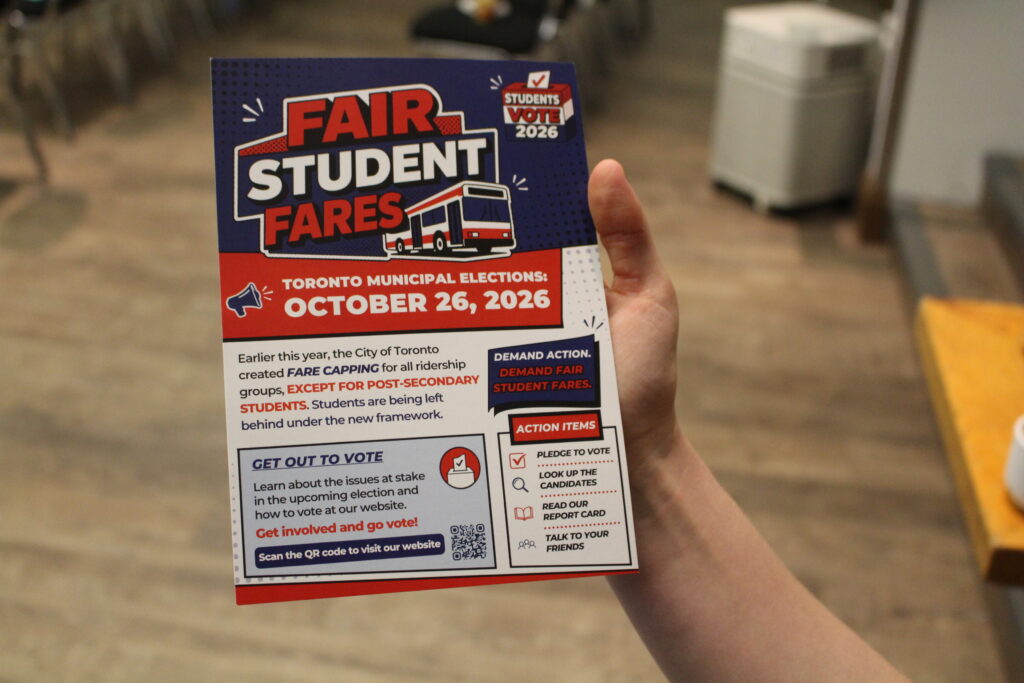
The event, whose flyers read that “Students are being left behind by the new (fare capping) framework” included speeches from activists and student leaders like; Andrew Pulsifer, the executive director of TTCRiders, Nicholas Silver, the vice president external of the University of Toronto Graduates Students Union, and Mohammad Akbar, the interim director at the Toronto Metropolitan Association of Part-Time Students.
Nicholas Silver, vice president external of the University of Toronto Graduates Students Union, says contacting candidates is the only way to get a fare capping program that works for students as well.
“We have contacted some candidates and some candidates have specifically included our request on campaign forms,” said Silver. “We do believe that this is the only way to get a fare capping program that works for everyone is to include students in it.”
Silver said some candidates included their request to include post-secondary students in the fare capping in their campaign forms. Mike Layton (who is running in Ward 11) was one of the names mentioned. According to Mike Layton’s public campaign platform, Layton would like to expand fare capping and ensure transit in the city is safe and reliable.
“A big hope for us and for TMAPS around transit is to ensure that continuing education and part-time students as well who might fall into a similar category are able to access those student programs,” said Mohammad Akbar, the interim director at the Toronto Metropolitan association of part-time students (TMAPS). TMAPS represents more mature students who take fewer classes than the standard full-time workload and Akbar says that part time students need to be more represented in discussions about student commuters.
“One thing we want the TTC to do better at is to make transit more affordable for post-secondary students,” says Andrew Pulsifer, the executive director of TTCRiders, an advocacy group for transit riders in Toronto and the GTA. Pulsifer says that transit affordability for postsecondary students is one of the goals of his organization. TTCRiders has created a pledge for municipal election candidates, which has been signed by over 50 people campaigning across Toronto. The TTC is heavily dependent on farebox revenue. According to a 2020 report, the TTC farebox recovery ratio was 67 per cent.
The event ended with attendees being asked to mention a good thing about the TTC and then writing suggestions and praise onto a piece of paper which was displayed in the middle of the circle.
When asked about how the TTC could better serve students, Pulsifer emphasized punctuality. “Just like everybody else, students just want their bus to come on time. That’s how they can address it, make sure the bus comes on time.”
Toronto’s municipal election is on Oct. 26.

Reporter, OTR, F2026.

Reporter, OTR, F2026.
